
Reviewed · STARGAZING & ASTRONOMY
Rapa Nui Stargazing
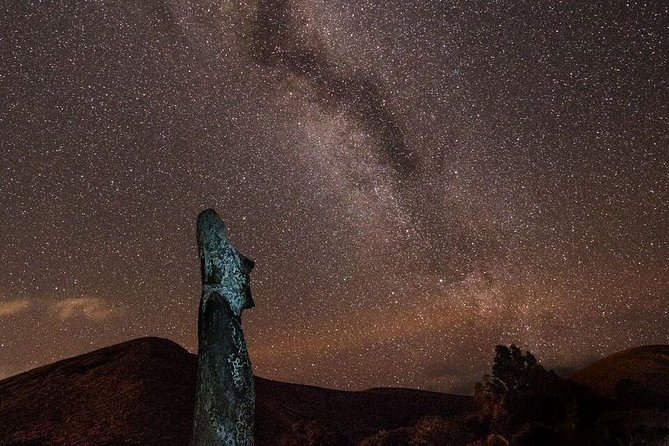
The best show begins after dark. Rapa Nui Stargazing takes you away from Hanga Roa toward Anakena Beach, where low light pollution, telescopes, and a local guide turn the night sky into the main event. I especially like the small groups of up to 12 and the chance to learn how Polynesian sailors used stars to cross the Pacific. The warm drink, local cake, and hotel drop-off are welcome touches.
The main catch is weather. The tour may be canceled close to departure, even when Hanga Roa looks clear, because conditions near Anakena can be cloudier or too windy for telescopes. I also recommend checking the exact meeting time carefully, since seasonal information gives different times.
In This Review
- Key things to know before you book
- Why Easter Island is a fine place to watch the stars
- Meeting at Katipare library in Hanga Roa
- Setting up the telescopes at the remote site
- The Polynesian navigation story
- Anakena Beach and Ahu Nau after dark
- Hot chocolate, local cake, and the late-night chill
- Weather, clouds, wind, and the full moon
- Is $140 a fair price?
- Who will enjoy this most?
- Practical tips for a better night
- Should you book Rapa Nui Stargazing?
- FAQ
- Where does Rapa Nui Stargazing meet?
- What time does the tour start?
- How long does the experience last?
- What is included in the price?
- Can the tour be canceled because of weather?
- Can I cancel my booking for a refund?
Key things to know before you book
- Anakena after sunset: The evening ends with special night access near Ahu Nau and photographs with the moai.
- Telescopes and binoculars: Depending on conditions, you may see the Moon, planets, star clusters, and other southern-sky objects.
- Polynesian navigation: The presentation connects astronomy with Rapa Nui culture and long-distance ocean travel.
- Weather can change the plan: Cancellations may happen shortly before departure, and a full moon can make the stargazing unsuitable.
- Bring warm layers and a light: The evening can feel chilly, and you will need a flashlight or headlamp in dark areas.
- Book early in your stay: A first-night booking leaves room to reschedule if clouds, rain, wind, or group numbers interfere.
Why Easter Island is a fine place to watch the stars
Rapa Nui is far from major cities and their bright nighttime glow. That makes the island a natural setting for astronomy, especially once you leave the lights of Hanga Roa and head toward the north coast.
The tour uses this setting well. Instead of simply stopping outside town and pointing upward, the guide drives you to a remote site before continuing to Anakena. Telescopes are set up there, giving the night a clear purpose and helping you see objects that are difficult to pick out with the naked eye.
The sky itself is the star of the outing, but the cultural setting gives the activity more meaning. The guides explain how Polynesian navigators read stars and used them to travel among distant islands. That link between the night sky and ocean travel makes the talk worthwhile even if you have never learned the difference between a planet and a star.
This is not just a photo stop with a quick astronomy explanation. The strongest part of the evening is the combination of science, local culture, and place. You are looking at the same broad sky that helped guide Pacific voyages, then finishing beside moai at Anakena.
More Rapa Nui trips and moai walks:
- From Hanga Roa: Rapa Nui Culture Sightseeing Tour
★ 4.6 · 307 reviews - From Hanga Roa: Easter Island Highlights 2-Day Tour
★ 4.3 · 205 reviews - From Hanga Roa: Easter Island Sightseeing Full Day Tour
★ 4.5 · 189 reviews
Meeting at Katipare library in Hanga Roa
There is no hotel pickup. You meet in front of Centro Lector Katipare, also called the Katipare library, in Hanga Roa. The published information gives 8:00 p.m. as the start time, with other seasonal guidance listing 7:30 p.m. in winter and 8:30 to 9:00 p.m. from September through April.
Because those times do not line up perfectly, confirm the exact departure time when your booking is confirmed. Do not rely only on a general seasonal rule. Arrive early at the library so you are not trying to find the group after dark.
A local driver and guide lead the outing. The vehicle transfer matters here because Anakena is away from Hanga Roa, and the astronomy site is remote. You do not need to arrange a separate taxi for the return, since hotel drop-off is included at the end.
The total outing lasts about three and a half hours. Several people have reported reaching their hotel around 1:00 a.m., so treat this as a late-night activity, not an early evening walk.
Setting up the telescopes at the remote site
The first major part of the evening takes place before the final beach stop. The guides set up telescopes at a darker location away from town, where artificial light is less of a problem.
The equipment has been used to show the Moon’s craters, Jupiter, Saturn and its rings, Sirius, the Pleiades, the Milky Way, and other star clusters or southern-sky objects. Exactly what you see depends on the date, cloud cover, the phase of the Moon, and the guide’s choices that night.
That uncertainty is part of astronomy, but it is worth setting expectations. You are not guaranteed a particular planet or nebula. A cloudy sky can limit the session, and one person felt there were too few chances to look through the telescope. If seeing many objects through the equipment is your top priority, ask how the evening will be organized when you arrive.
The guides also use binoculars and, at times, a laptop or tablet to explain maps and star patterns. This can help you understand the presentation, but a small screen may be hard to see if the group is larger or standing spread out. With a smaller group, it is easier to gather around the screen and ask questions.
The best accounts of the experience praise the clear explanations and the easy way the guides handle questions. Mark is specifically praised for his astronomy and Polynesian navigation talk. The presentation is aimed at ordinary people, not only serious amateur astronomers, so you do not need prior knowledge.
The Polynesian navigation story
This cultural section gives the tour its strongest sense of place. Rapa Nui is often discussed through its moai, but the island also belongs to a much wider Polynesian world of ocean travel, wayfinding, and star knowledge.
The guide explains how Polynesian sailors used the heavens to navigate across the Pacific. That may include star positions, island routes, and the way familiar celestial markers helped sailors maintain direction. The exact presentation can vary by guide, but the central idea is clear: these were not random voyages across empty water.
I like this part because it turns stargazing into a story about human skill. You are not only learning the names of stars. You are considering how people reached remote islands without modern navigation equipment.
If you have children or teenagers in your group, this may be the part that keeps their attention. The combination of telescopes, ancient navigation, and a dark beach is more memorable than a standard indoor astronomy talk.
More night sky trips from Easter Island:
- The Rapa Nui Stargazing Experience
★ 4.5 · 32 reviews - Easter Island: Rapa Nui Stargazing Tour
★ 4.8 · 16 reviews - Astronomical Tour on Easter Island
★ 3.5 · 3 reviews - Rapa Nui Astrophotography and Stargazing Night Tour Combination
★ 5.0 · 3 reviews
Anakena Beach and Ahu Nau after dark
After the telescope session, the group drives to Anakena Beach. The itinerary describes special nighttime access to Ahu Nau, which is the final stop.
Anakena gives the evening a powerful finish. The beach is associated with moai, and seeing the figures after dark creates a different mood from a daytime visit. The darkness, open sky, and sound of the sea provide a quiet setting for photographs.
The photo session is an important part of the tour, though it may take longer than you expect. The guides can take long-exposure photographs of you near the moai, producing the type of image that is difficult to make with a phone. One account praised the final photographs, while another found the process of arranging the pictures and collecting email addresses somewhat confusing.
Photos may be available to purchase, so ask how the image delivery works before the group begins. If you want a smooth photo session, have your email address ready and listen carefully for instructions.
The experience can also include music. One account describes Mark singing and playing guitar during the photo session, while another mentions music playing as the pictures were taken. This is not the central promise of the tour, so think of it as a possible extra rather than something to book solely for the performance.
Hot chocolate, local cake, and the late-night chill
A hot beverage and local cake are included. Several descriptions single out the hot chocolate as a highlight, with Tuhii receiving special praise for making it.
This small refreshment matters more than it might sound. Rapa Nui can feel warm during the day, but sitting outside at night for several hours is different. Bring a jacket or at least one long-sleeve layer, even if the afternoon was hot.
You should also bring a flashlight or headlamp. The remote viewing area and beach are dark by design, which is good for stargazing but less convenient when walking or finding your footing. A phone light is better than nothing, but a small headlamp leaves your hands free.
Wear shoes suitable for standing and walking on uneven ground. The supplied information does not promise a specific walking route or terrain, so use sensible footwear rather than beach sandals.
Weather, clouds, wind, and the full moon
Weather is the biggest practical issue. The tour requires favorable conditions, and the operator checks conditions near Anakena rather than relying only on the sky over Hanga Roa.
That distinction explains why the tour may be canceled when town looks clear. Telescopes cannot be used comfortably in strong wind, and clouds or rain can ruin the main purpose of the evening. From the visitor’s point of view, a late cancellation is frustrating, but a telescope session under poor conditions would not offer good value either.
The tour may be confirmed or canceled close to departure, sometimes about an hour before the scheduled meeting. This makes it hard to plan a backup dinner or evening activity with total confidence. Keep the night flexible.
A full moon is another factor. Bright moonlight can wash out many stars, so the operator does not generally run the stargazing experience close to full-moon dates. You may be offered a full-moon hike instead, but that is a different activity and should not be treated as an equivalent replacement.
My best advice is simple: book this near the beginning of your Easter Island stay. If clouds or wind cancel the outing, you have more opportunity to move it to another night. Rescheduling depends on availability, so it is not guaranteed, but an early booking gives you the best chance.
If the outing is canceled completely because of poor weather or too few participants, you can choose an alternative date or receive a full refund. If conditions change after the tour has started, the operator may try to take you out again free of charge on another night, subject to availability.
Is $140 a fair price?
At $140 per person, this is not a cheap night out. You are paying for transport to a remote site, a local guide, astronomy equipment, cultural interpretation, refreshments, special nighttime access near Ahu Nau, and hotel drop-off.
The price makes more sense if you value the full package. A basic self-guided look at the stars costs less, but it will not provide the same telescope access, explanation of Polynesian navigation, organized transport, or long-exposure photographs beside the moai.
The value depends heavily on weather. On a clear night, the combination of the Milky Way, planets, telescopes, and Anakena photos can justify the cost. On a cloudy night, the experience may become mostly a cultural talk and photo stop, if it runs at all.
The maximum group size is 12, which helps keep the session personal. A smaller group makes it easier to ask questions and take turns at the telescopes. The operator may cancel if too few people sign up, so the small-group promise comes with a little scheduling risk.
You can cancel for a full refund up to 24 hours before departure. Changes or cancellations within 24 hours generally do not qualify for a refund, except when the operator cancels because of weather or minimum group numbers.
Who will enjoy this most?
I would recommend this for anyone curious about the night sky, Polynesian navigation, or the moai in a completely different setting. It works especially well for couples, families with older children, solo visitors who want an organized evening, and amateur astronomers who enjoy learning from local guides.
You do not need to know astronomy in advance. The guides explain the subject in an approachable way, and the equipment gives you something concrete to look at.
It may be less suitable if you need a firm schedule or dislike late-night plans. It is also a poor fit if you are visiting Easter Island for only one night and cannot tolerate the possibility of cancellation. In that case, book only if you have a backup plan and understand that clear skies in Hanga Roa do not guarantee clear skies at Anakena.
Practical tips for a better night
- Book your first available night: This leaves time to reschedule after a weather cancellation.
- Check the moon phase: Full-moon dates may not operate as standard stargazing nights.
- Confirm the meeting time: Seasonal departure details vary, so verify the time directly.
- Arrive at Katipare library early: There is no hotel pickup.
- Bring a jacket: Evening temperatures can feel much cooler than daytime conditions.
- Pack a flashlight or headlamp: The viewing site and beach are dark.
- Keep your late evening free: The outing can last until about 1:00 a.m.
- Prepare your email for photographs: This can make the photo process easier.
- Ask questions: The guides can explain star patterns, planets, and Polynesian wayfinding in more detail.
Should you book Rapa Nui Stargazing?
Book it if you want more than a standard night tour. The strongest version of this experience combines a dark Easter Island sky, useful telescope viewing, Polynesian navigation, warm chocolate, local cake, and photographs with the moai at Anakena.
I would book it early in my stay, watch the moon phase, and accept that weather may decide the outcome. The late confirmation is the main weakness, but it comes from the real difficulty of stargazing on a remote island with changing conditions.
For a clear night and a small group, $140 can be fair value. For someone who needs certainty, dislikes late nights, or has no spare evening, the risk may outweigh the reward.
FAQ
Where does Rapa Nui Stargazing meet?
The group meets in front of Centro Lector Katipare, also known as the Katipare library, in Hanga Roa. Hotel pickup is not included.
What time does the tour start?
The general start time is listed as 8:00 p.m., but seasonal information also gives 7:30 p.m. in winter and 8:30 to 9:00 p.m. from September through April. Confirm the exact time for your date.
How long does the experience last?
The tour lasts approximately three hours and 30 minutes. Some outings may return to hotels around 1:00 a.m.
What is included in the price?
The price includes a driver and guide, live commentary, telescopes and astronomy activities, hotel drop-off, a hot beverage, local cake, and a small-group format with a maximum of 12 people.
Can the tour be canceled because of weather?
Yes. The experience requires favorable weather, and the operator may cancel because of clouds, rain, or strong wind near Anakena. You can then choose another date or receive a full refund.
Can I cancel my booking for a refund?
You can cancel at least 24 hours before the scheduled start for a full refund. Cancellations or changes made less than 24 hours before departure are generally not refunded.
Just added around Easter Island
- Volcanic Refuges: Excursion to Underground Civilization★ 4.7 · 8 reviews
- Easter Island Ancestral Dinner and Show with Transport★ 4.5 · 2 reviews
- Volcanic Wonders and the Kingdom of the Birdman: Half Day★ 5.0 · 6 reviews
- Half Day Private Tour: Caves and Volcanic Refuges★ 4.0 · 14 reviews
- Tour to the Motus: Boat trip and snorkeling in Rapa Nui★ 5.0 · 8 reviews
- Birdman Ceremonial Route: Orongo, Ranu Kau Half-Day Tour★ 4.5 · 16 reviews
- Visit Rapa Nui in 4 days with 3 Tours and Accommodation included★ 4.0 · 2 reviews
- Private Tour: Tongariki Sunrise Experience★ 4.5 · 20 reviews
Stargazing & Astronomy, compared.
The Roofless Experience San Pedro de Atacama Stargazing Tour
Read our review →


Astronomical Tour with Guide and Pick Up San Pedro de Atacama
Read our review →
“Astronomical Adventure in San Pedro de Atacama”
Read our review →Browse the lists this tour appears in