
Reviewed · ATACAMA DESERT TOURS
Astronomical Tour with Guide and Pick Up San Pedro de Atacama
Look up, and the desert answers back. This 2.5-hour night tour takes you outside San Pedro de Atacama for telescope views of planets, star clusters, galaxies, and southern constellations. I especially like the expert-led explanations and the chance to receive a professional night-sky photograph. The $38 price is also fair for transport, equipment, drinks, snacks, and a guided astronomy lesson.
The main catch is simple: the moon and weather matter. A bright moon can wash out the Milky Way, and cloudy or windy conditions can limit what you see. Group size and language balance can also affect the pace, so you should choose your date with care and confirm how the evening will be handled.
In This Review
- Key things to know before you go
- Why San Pedro is such a good place for stargazing
- What happens after the 9:30 p.m. pickup
- The telescope session: patience brings the best views
- The guide can make or break the evening
- Moon phase is the most important booking decision
- Astrophotography gives the evening a lasting souvenir
- Drinks, blankets, and the practical comforts
- Is $38 a fair price?
- Who should book this astronomy tour?
- Should you book it?
- FAQ
- What time does the astronomy tour begin?
- Is hotel pickup included?
- How many people can join the tour?
- What can I see through the telescopes?
- Is astrophotography included?
- Are drinks and snacks included?
- What happens if bad weather cancels the tour?
Key things to know before you go
- The tour begins at 9:30 p.m. and includes pickup from eligible accommodations in San Pedro de Atacama.
- Two or more telescopes are used, including computerized and manual equipment, with time to view selected objects through the eyepiece.
- Patricio is a major strength of the experience, offering clear, friendly explanations about stars, planets, galaxies, and the scale of the universe.
- Moon phase changes the experience: a dark sky is best for the Milky Way, while a bright moon can still produce excellent lunar views.
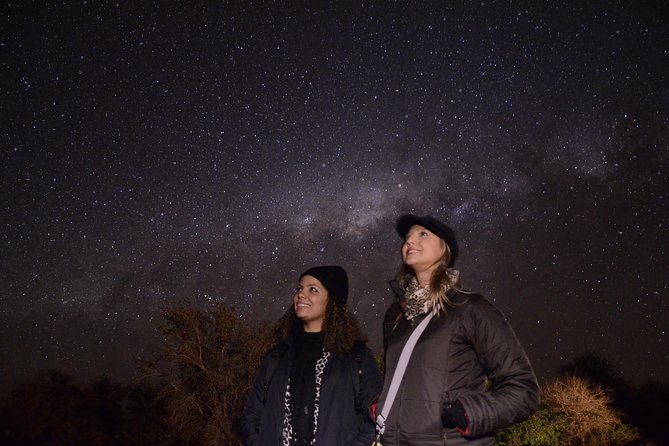
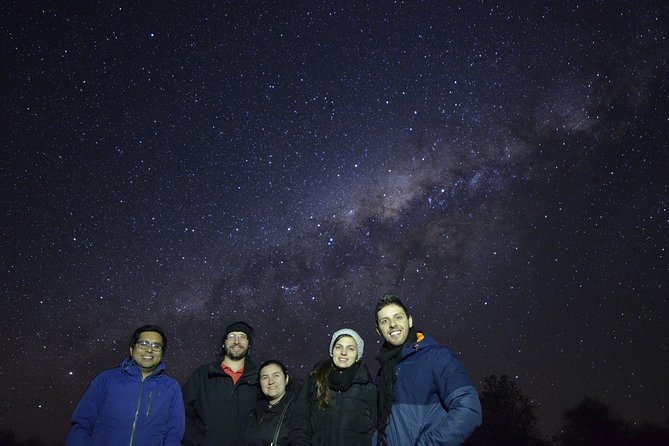
- Professional astrophotography is included without the moon, and photographs of you beneath the stars are provided as a souvenir.
- The group limit is listed as 16 people, though one busy-period account described a group larger than that, so expect some variation during peak dates.
Why San Pedro is such a good place for stargazing
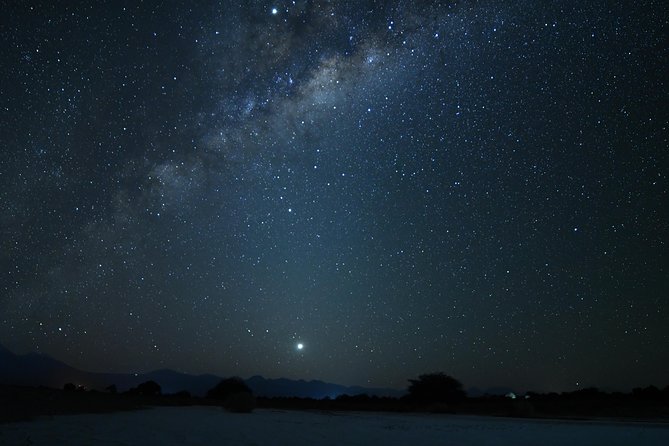
San Pedro de Atacama sits in one of the world’s most famous astronomy regions. The high desert is valued for its dry air and dark night skies, which make faint stars and distant objects easier to see than they are in a bright city.
You do not need to know the names of constellations before you arrive. The guide uses an astronomical laser pointer to identify major formations in the southern sky and explains what you are seeing in plain language. That matters because the sky can look like a pile of glitter at first. A good guide gives it order.
The southern hemisphere also offers a different set of stars and constellations from those visible in Europe or North America. Depending on the season, you may see planets, clusters, galaxies, nebulae, and individual stars through the telescopes. The exact menu changes with the time of year, darkness, moon phase, and cloud cover.
The setting is not a large scientific observatory with giant research instruments. It is a small, practical observing site near San Pedro, with chairs, blankets, telescopes, and space to gather around the equipment. That makes the experience more personal, but it also means you should keep your expectations realistic. You are taking part in a guided public astronomy session, not receiving images from a space telescope.
More Stargazing Tours in San Pedro de Atacama
- San Pedro de Atacama: Etno-Stargazing Tour with Transfer
★ 4.8 · 629 reviews - The Roofless Experience San Pedro de Atacama Stargazing Tour
★ 5.0 · 522 reviews - San Pedro de Atacama: Stargazing Experience
★ 4.7 · 489 reviews
What happens after the 9:30 p.m. pickup
Pickup is included from accommodations in San Pedro de Atacama, and the tour begins at about 9:30 p.m. The drive to the observing site is short, but hotel collection can take time. One account described roughly 15 to 20 minutes spent picking people up, followed by a 10 to 15 minute ride to the site. Another described a much longer pickup and return process during an especially crowded holiday weekend.
That difference is useful to keep in mind. Your advertised activity lasts around two and a half hours, but the actual stargazing time can be shaped by the number of pickup stops and the size of the group. I would avoid scheduling an early morning excursion immediately afterward, especially if you want to enjoy the evening without watching the clock.
Pickup is not offered from every outlying area. The listed exclusions are the ayllus of Cucuter, Tulor, Coyo, Solor, and Quitor. If you are staying in one of those areas, check the meeting arrangement before paying. A confirmed booking is normally issued at the time of reservation.
At the site, chairs and blankets help with the desert cold. The temperature can drop quickly after dark, so the blankets are more than a decorative extra. Bring warm layers anyway. Coffee, tea, soda, snacks, and alcoholic drinks are included, with some accounts describing wine, whiskey, and hot drinks served after the observing session.
The telescope session: patience brings the best views
The central part of the night is spent moving between the telescopes. The guide selects objects, points the equipment, explains what you are seeing, and then allows each person a turn at the eyepiece.
This format has a clear advantage: you can see objects that are difficult to identify with the naked eye. Depending on the night, the telescope may reveal the Moon’s surface, Saturn, Jupiter, star clusters, or other distant objects. One particularly memorable report described seeing storms on Saturn and Jupiter. Another praised the Moon’s detail, even during a full-moon period.
The tradeoff is waiting. If the group is full and only two telescopes are operating, you may spend part of the evening standing or sitting while other people take their turns. Some people describe three or four minutes of total telescope viewing, while others say they had plenty of time and never felt hurried. The difference may come down to the number of people present, the guide on duty, and the night’s conditions.
For the best experience, treat the explanations as part of the tour rather than as filler between telescope turns. Patricio has been praised for making complex ideas easy to follow, including the enormous distances and time scales involved in astronomy. He also answers questions and keeps the lesson accessible for families and people with no science background.
The telescopes are described as reflecting instruments that use concave mirrors to collect light. They are capable of showing real detail, but they cannot produce the highly processed images associated with major observatories or space missions. Atmospheric conditions still affect the view, and the image in the eyepiece may be smaller or less colorful than you expect from astronomy photographs.
That is not a flaw in itself. It is simply the difference between looking through a telescope with your own eyes and viewing a long-exposure image processed by computers. The thrill here is direct observation. You are seeing the object through the instrument at that moment, with the guide explaining what makes it interesting.
The guide can make or break the evening
The strongest part of this experience is the human side. Patricio is repeatedly praised for his command of astronomy, his friendly manner, and his ability to explain difficult subjects without making the lesson feel like school.
Nathan has also received strong praise for his astronomy knowledge and passion. One family found his English excellent and appreciated that he chose to present in English even though they also understood Spanish. That kind of effort matters when the subject depends on precise explanations.
Language can be less consistent on some departures. In several accounts, the main presentation was in Spanish, with a second guide translating into English. This worked well at times, but it could become confusing when the two guides were speaking at once or when one was busy helping people at a telescope.
If you need a full English presentation, ask about the language arrangement before booking. The tour is not automatically the same from one night to the next. A bilingual guide can make the experience very rewarding, but rushed translation may leave you unsure which constellation or planet the laser is indicating.
The guide’s skill also affects the pace. A strong presenter keeps the group involved while equipment is adjusted and people take turns. A less organized session may feel slow, especially when photography takes up a large part of the night.
Other Atacama desert trips from San Pedro de Atacama:
- San Pedro de Atacama: El Tatio Geysers Tour
★ 4.7 · 943 reviews - Half Day Tour to Geysers del Tatio
★ 5.0 · 499 reviews - San Pedro Atacama: Baltinache Lagoons
★ 4.6 · 359 reviews - San Pedro de Atacama: Valle de la Luna Guided Tour
★ 4.4 · 312 reviews
Moon phase is the most important booking decision
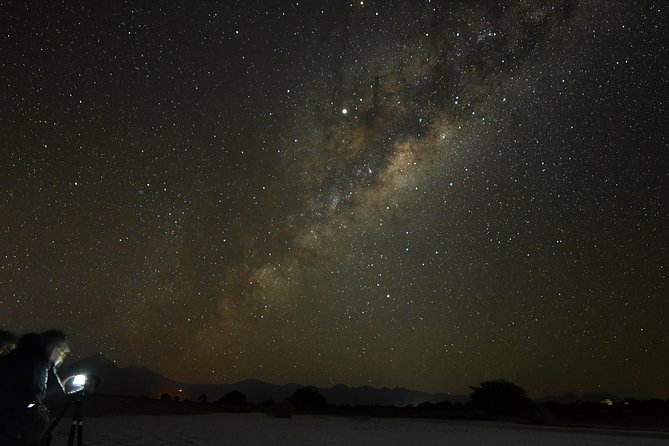
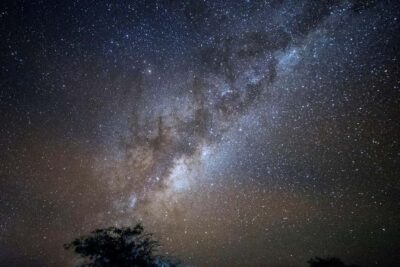
The Moon changes the character of the tour more than almost any other factor. On a moonless night, faint stars and the Milky Way have the best chance of appearing clearly. If your main goal is a dramatic band of stars across the sky, aim for a new moon or a period with little moonlight.
A bright Moon is not a complete failure. It can become the star of the evening, with craters and ridges visible through the telescope in striking detail. You may also see planets, bright stars, and clusters. One account described excellent full-moon photographs and many visible stars despite the lunar glare.
Still, you should not book a full-moon date expecting the same view as a dark-sky night. A half or full Moon can make the sky appear less dramatic to the naked eye and may prevent astrophotography of the Milky Way. If the listing offers a lunar experience at your date, think of it as a different version of the tour rather than a lesser one.
Clouds and wind matter as well. The operator may cancel because of poor weather, and a replacement date or full refund is offered in that situation. There have been cases of last-minute weather decisions and communication problems, so keep your phone available on the afternoon and evening of the tour. If the sky looks clear to you but the operator cancels, ask for the cancellation and refund details through the booking platform.
Summer conditions deserve extra attention. A local account described cloudy conditions during January, February, and March, when high-altitude rain can affect the Atacama region. The operator says it relies on weather reports, satellite views, wind, humidity, and cloud information rather than making a decision from one person’s view of the sky. The practical lesson is to keep a spare night in your schedule if astronomy is a priority.
Astrophotography gives the evening a lasting souvenir
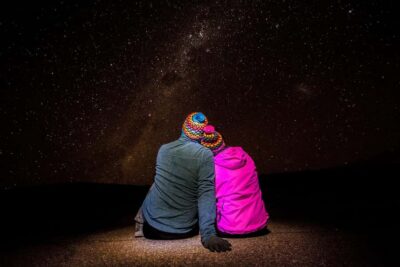
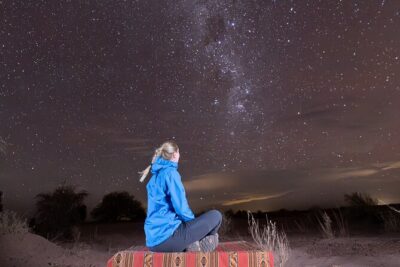
The included photographs add value, especially for people who want a picture of themselves beneath the Atacama sky. The operator uses a professional camera setup, and several people describe the finished images as beautiful or high quality.
Astrophotography is listed as included without the Moon. That wording matters. A dark sky is needed for the classic star-filled portrait, while a bright Moon may produce a lunar photograph instead. The result can also depend on wind, focus, timing, and the number of people waiting.
Photography can take longer than expected. When everyone gathers around the camera and requests several poses, the session may cut into telescope time. If you care more about seeing celestial objects than receiving many portraits, say so politely and keep the photo portion moving.
You may also be able to photograph the Moon through the telescope with your own phone. One family used a cell phone to capture lunar views with help from the guide. Another participant received patient assistance setting up a personal camera for amateur astrophotography. Bring your phone or camera if you want to try, but do not expect the guide to provide a full private photography lesson in a busy group.
Drinks, blankets, and the practical comforts
The included refreshments are a pleasant finish to a cold night. Coffee and tea provide warmth, while wine, whiskey, soda, and snacks make the return to the chairs feel social. The range of options has been praised, though the timing can vary.
Some accounts describe drinks being served only after the telescope session. If you expect a hot drink while waiting, that may be a small disappointment. The blankets and chairs are useful because the observing position can involve long periods outdoors, with little movement.
A bathroom is available at the site. Most people can take part, and the activity is suitable for families, couples, solo visitors, photographers, and anyone curious about science. Children may especially enjoy the Moon and planets because they offer immediate detail through the telescope, while the larger ideas about galaxies and star life give adults plenty to think about.
Is $38 a fair price?
At $38 per person, this is a good-value introduction to astronomy if the weather cooperates and the group stays close to its advertised size. You receive transport from San Pedro, chairs, blankets, telescopes, guide commentary, refreshments, bathroom access, and a professional photograph. Renting a car and finding your own dark spot would not provide the same explanation or telescope access.
The price is less attractive if your only goal is a long period of uninterrupted telescope viewing. In a larger group, you may wait often, and the return transfer can take longer than expected. You are paying for a hosted experience, not a private observing session.
The group limit is listed as 16 people, but one busy-period account described more than 20. Holiday weekends can bring crowding across San Pedro, and the operator itself acknowledged that peak dates can make the session less orderly. For better value, book outside major holiday periods if your schedule allows. The operator specifically points to April through August, apart from holiday weekends, as a quieter period.
The tour is often booked about 23 days ahead, which suggests that popular dates can fill early. If you are visiting San Pedro for only a few nights, reserve ahead and keep one possible backup evening open.
Who should book this astronomy tour?
I would choose this tour if you want a clear introduction to the southern sky without arranging transport or learning how to operate a telescope. It is particularly good for families, couples, and first-time stargazers who value a guide’s stories as much as the views.
It also suits you if you want a ready-made night out with blankets, drinks, snacks, and a souvenir photograph. Patricio’s explanations can turn a quick look at Saturn or a cluster of stars into a memorable lesson about how the universe works.
I would think twice if you dislike group activities, waiting in line, or translated presentations. A private astronomy session would likely give you more time at the eyepiece, but that is not what this $38 experience promises.
Plan around the Moon. If the Milky Way is your main target, choose the darkest possible date. If your visit falls near a full Moon, go for the lunar views, planets, and the guide’s explanations instead.
Should you book it?
Yes, if you understand that this is a friendly public astronomy night rather than a private observatory visit. The best reasons to book are the skilled guides, the southern-sky setting, the chance to view planets and clusters through telescopes, and the included photograph.
Book with a little flexibility. Avoid relying on a tightly packed next morning, check the moon phase, confirm pickup eligibility, and ask about the presentation language. With a dark, clear sky and a manageable group, this can become one of the most memorable parts of your time in San Pedro de Atacama.
FAQ
What time does the astronomy tour begin?
The tour starts at 9:30 p.m. The total activity lasts about 2 hours and 30 minutes, including transportation and the observing session.
Is hotel pickup included?
Yes, pickup from accommodation in San Pedro de Atacama is included. Pickup is not provided from the ayllus of Cucuter, Tulor, Coyo, Solor, or Quitor.
How many people can join the tour?
The listed maximum is 16 people. Group size may vary during especially busy periods, so confirm the expected size if that is important to you.
What can I see through the telescopes?
Depending on the season and conditions, you may see planets, star clusters, galaxies, stars, the Moon, and other celestial objects. The exact views depend on weather, visibility, and moonlight.
Is astrophotography included?
Yes, astrophotography is included when there is no Moon. Professional photographs of you beneath the stars are also provided as a souvenir.
Are drinks and snacks included?
Yes. The inclusions list coffee or tea, soda, alcoholic drinks, and snacks. Blankets, chairs, and access to a bathroom are also included.
What happens if bad weather cancels the tour?
If poor weather causes cancellation, you can choose another date or receive a full refund. You can also cancel your own booking at least 24 hours before the start time for a full refund.
Just added around San Pedro de Atacama
- Vallecito★ 4.7 · 13 reviews
- Atacama Desert and Magic Bus Visit★ 4.8 · 15 reviews
- San Pedro de Atacama: Valle de la luna★ 3.0 · 3 reviews
- Valle de la Luna: A Moon-Like Escape in Atacama★ 5.0 · 3 reviews
- 3 Perfect Days in Atacama + Transfer★ 4.5 · 3 reviews
- Atacama Stargazing Tour Under One of the World’s Clearest Skies★ 4.0 · 3 reviews
- Moon Valley Tour, the Best Seller★ 4.5 · 2 reviews
- Tour to Laguna Cejar and Tibenquinche★ 4.5 · 7 reviews
Atacama Desert Tours, compared.
The Roofless Experience San Pedro de Atacama Stargazing Tour
Read our review →
Browse the lists this tour appears in