
Reviewed · EASTER ISLAND TOURS
Private Tour: The Highlights of Easter Island
Fifteen moai make quite an entrance. This private Easter Island tour packs Rapa Nui’s major sights into one well-planned day, with an English-speaking local guide, hotel pickup, and a private air-conditioned vehicle. I especially like the freedom to adjust the route and the chance to see both famous ceremonial sites and quieter moai locations. The main drawback is the price: at $200 per person, it costs more than arranging a basic local outing yourself.
You get about seven hours on the road, with time at seven major sites. I also like that guide Joaquin has proved flexible when guests had already visited some places, changing the plan instead of repeating them. Still, this is a full day with limited time for a leisurely lunch, and the national park fee is not included.
In This Review
- Five things to know before you book
- Why a private day makes sense on Rapa Nui
- Anakena Beach and the first chapter of Rapa Nui
- Ahu Tongariki and the island’s greatest row of moai
- Rano Kau, a crater with water and silence
- Ahu Akivi and seven moai facing the sea
- Rano Raraku, where the moai were made
- Ahu Tahai and the remains of daily life
- Orongo and the birdman contest
- What $200 per person really buys
- Who should book this tour
- Should you book the Highlights of Easter Island?
- FAQ
- How long does the private Easter Island tour last?
- What time does pickup begin?
- Is the tour private?
- Is lunch included?
- Is the national park fee included?
- Can cruise ship passengers book this experience?
Five things to know before you book
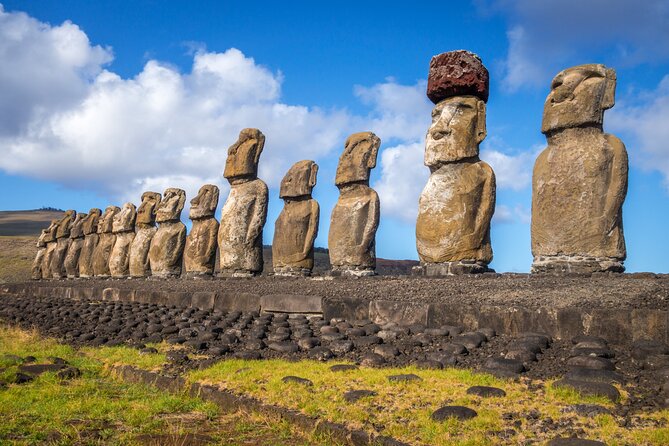
- Fifteen moai at Ahu Tongariki: Rapa Nui’s largest ceremonial platform makes an unforgettable centerpiece for the day.
- A private route with Joaquin: The guide can work around places you have already seen and add less familiar moai sites.
- Rano Raraku is the big payoff: You see unfinished statues still attached to the volcanic quarry where nearly 1,000 moai were made.
- Orongo adds the human story: Petroglyphs and the birdman competition explain a later struggle for power on the island.
- $200 buys convenience and flexibility: Hotel pickup, private transport, water, and a local guide make the cost easier to justify for couples or small groups.
Why a private day makes sense on Rapa Nui
Easter Island is not a place where you want to spend your limited time guessing which road leads to the next ahu. The island’s famous sites are spread across a compact but sometimes time-consuming route, and the meaning of each place becomes clearer when someone connects the stones, clans, ceremonies, and changing political order.
This tour gives you a private group from start to finish. That matters most at sites such as Rano Raraku and Orongo, where you may want extra time for questions, photographs, or a closer look at details that are easy to miss. You are not tied to the pace of a large coach group.
The advertised start time is 9:00 a.m., while pickup is generally around 9:30 unless you arrange another time. Confirm the exact pickup when you book. You return to your hotel after roughly seven hours, so the day is built for sightseeing rather than a slow beach outing.
The vehicle is air-conditioned, and bottled water is included. Lunch is not. Since the stops cover much of the island, bring a practical snack if you need one, though the tour information does not specify meal arrangements.
More Private Tours in Easter Island
- 2-Day Private Tour Easter Island Highlights Complete Discovery
★ 5.0 · 110 reviews - Private Full-Day Easter Island Highlights North and West
★ 5.0 · 84 reviews - Full Day Private Tour: Factory of the Moai the stone giants
★ 4.5 · 63 reviews
Anakena Beach and the first chapter of Rapa Nui
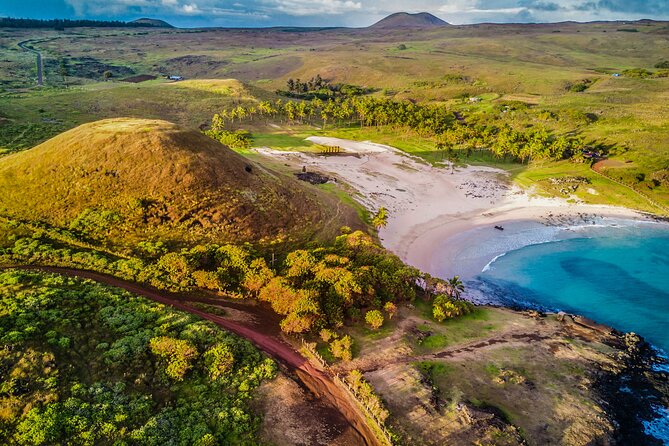
Anakena gives the day a gentle opening. Its sand and palms make it look like a beach stop, but its importance is cultural rather than simply scenic.
Rapa Nui tradition places the landing of the first king, Hotu Matu’a, here. The area became an early settlement and an important center for the Miru tribe. Archaeological remains date to around 1200 AD and include ceremonial platforms, homes, and other signs of organized community life.
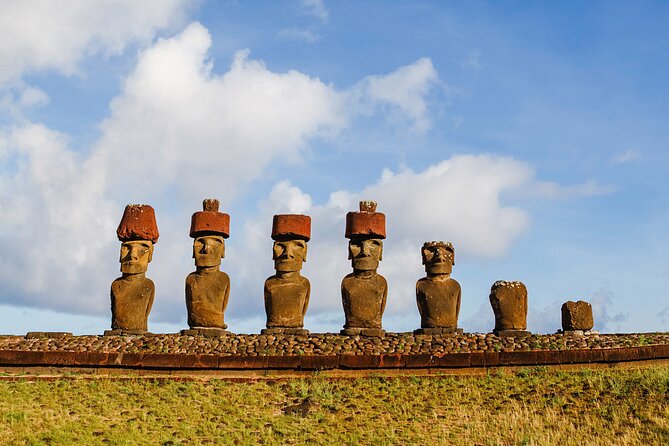
You see Ahu Ature Huki, with one restored moai, and Ahu Nau Nau, where seven finely carved moai form the main attraction. Ahu Nau Nau is especially rewarding because several statues were protected by sand after they fell. That helped preserve details that weather and time erased elsewhere.
You have about an hour here, and admission is included. I would use the time to look closely at the backs and sides of the statues, not only the familiar front view. The beach is easy to appreciate quickly, but the archaeological remains deserve your attention.
Ahu Tongariki and the island’s greatest row of moai
If one stop gives you the classic Rapa Nui image, it is Ahu Tongariki. Fifteen moai line a ceremonial platform about 100 meters long, with the Pacific behind them and the volcanic interior rising beyond.
The scale is hard to grasp in photographs. Each statue has a different shape, height, and expression. Together they suggest the importance of ancestors and the power held by the community that built and maintained this center.
Tongariki is thought to have served religious and political purposes from around 900 AD. The site was later badly damaged, then carefully restored. That restoration lets you see the ahu and its statues as a coherent monument rather than as scattered stones.
Plan on one hour here, with admission included. Your guide can help you read the site as more than a line of giant heads. The moai represent ancestors, and their different forms reflect changes in carving style over time.
This is also a good place to slow down. The other stops offer caves, petroglyphs, a quarry, and a crater. Tongariki gives you a single powerful view that needs little explanation to make an impression.
Rano Kau, a crater with water and silence
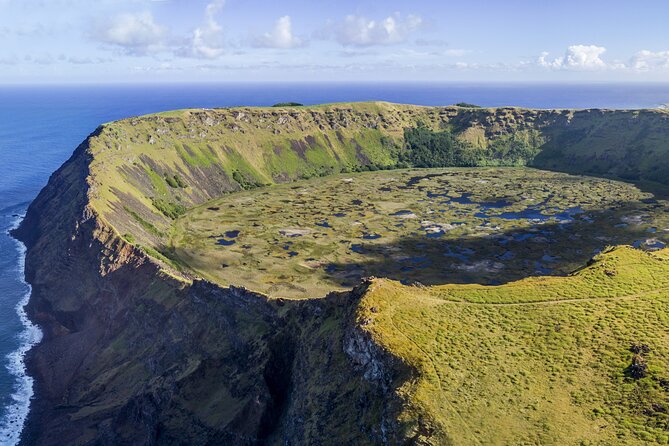
Rano Kau changes the mood. The almost circular volcanic crater measures about 1.5 kilometers across, and its interior contains a lake that once supplied drinking water.
The crater also holds one of the island’s largest reserves of endemic plant life. Obsidian from nearby volcanic areas such as Maunga Orito and Maunga Te Manavai was used to make tools and other objects.
You spend about 30 minutes here, and there is no admission charge listed for this stop. That is enough for the main view, though anyone who enjoys geology or plant life may wish the schedule allowed more time.
The appeal is not just the size of the crater. It is the quiet. Wind and distant waves provide most of the sound, giving you a useful pause between the ceremonial centers and the more demanding archaeological stops.
More Rapa Nui trips and moai walks:
- From Hanga Roa: Rapa Nui Culture Sightseeing Tour
★ 4.6 · 307 reviews - From Hanga Roa: Easter Island Highlights 2-Day Tour
★ 4.3 · 205 reviews - Full Day Tour in Rapa Nui
★ 4.5 · 122 reviews - From Hanga Roa: Journey from Orongo to Ana Te Pahu
★ 4.3 · 75 reviews
Ahu Akivi and seven moai facing the sea
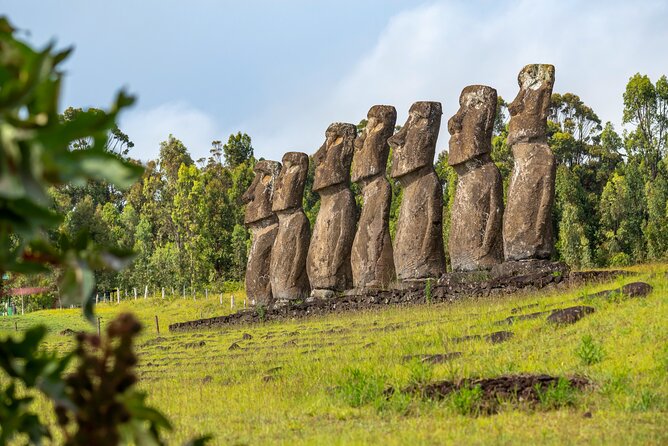
Ahu Akivi is unusual in several ways. It is inland, it has a deliberate astronomical orientation, and its seven moai face toward the sea. Many other statues on Rapa Nui are associated with inland-facing community spaces, so this arrangement invites questions about who the statues represent.
The seven figures are linked to the island’s first explorers or to ancient Polynesian kings. They are also associated with the powerful Miru clan. Their careful construction suggests a period of political order and enough resources to organize a major project.
The statues were moved about 15 kilometers from the Rano Raraku quarry. That distance helps you appreciate the physical work behind the monuments, even before your guide explains the cultural meaning.
This is a 30-minute stop with admission included. It is short, but the site has a clear identity and does not need a long walk to understand. I would pay attention to the orientation and setting here, since that is what makes Ahu Akivi different from Tongariki or Tahai.
Rano Raraku, where the moai were made
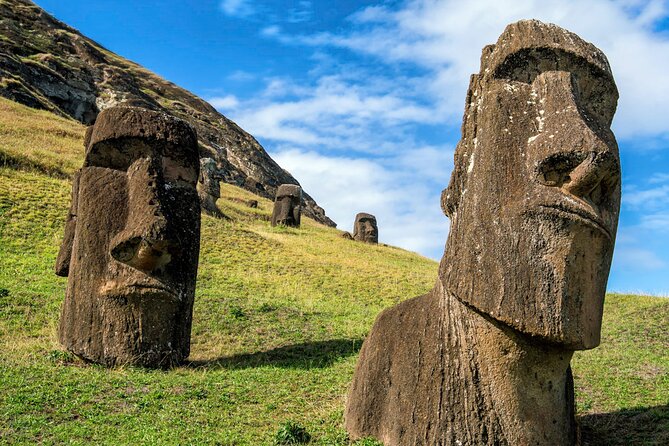
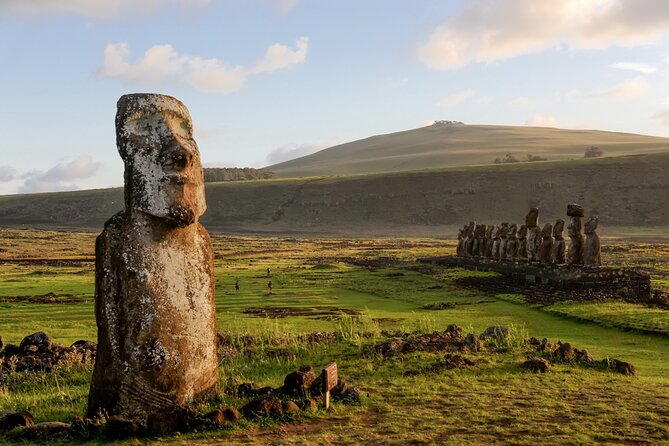
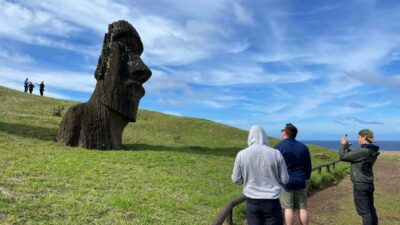
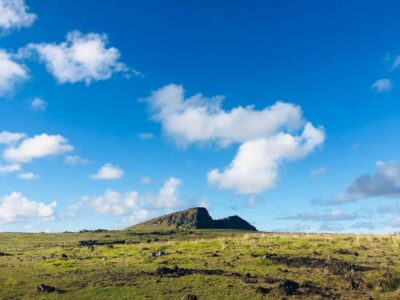
Rano Raraku is the stop that best explains how Rapa Nui’s statues came into being. This volcanic quarry supplied the distinctive tuff used by sculptors for nearly 1,000 moai across the island.
You see unfinished figures in the rock and empty niches where statues were cut away. Dozens of stone heads and bodies remain on the slope, making the site feel like a workshop paused in the middle of a project.
The unfinished moai raise practical questions. How far had a statue been carved before it was removed? Why was one abandoned? How did the island’s workers move these enormous figures from the quarry to their ahu? Your guide can place those questions in the wider story of Rapa Nui society without turning the stop into a dry archaeology lecture.
You get about 90 minutes here, the longest stop of the day. That is welcome. Rano Raraku rewards patience because the statues are not arranged in one neat row. You need time to notice figures partly buried in the slope and to compare the carving stages.
Admission is included in the tour details, but the separate national park fee is not. Check how that fee will be handled before departure so you know the full cost.
Ahu Tahai and the remains of daily life
Tahai offers a different kind of history. Instead of focusing only on monumental statues, it helps you picture an occupied settlement.
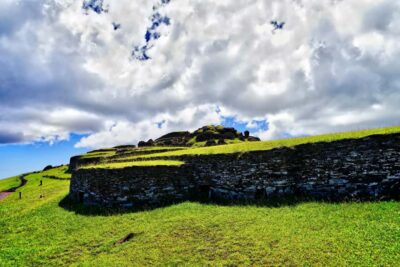
The Marama and Miru clans used this area as a political and religious center. Archaeological work found evidence that roughly 75 to 200 people lived here, using nearby caves and rocky shelters as rooms.
Three ahu form the heart of the complex: Ahu Vai Uri, Ahu Tahai, and another ceremonial platform in the group. A stone ramp between two of them may have helped lower fishing boats from higher ground to the shore. It is a small but useful reminder that the people who built the moai also solved ordinary problems involving food, shelter, and the sea.
You have about 40 minutes at Tahai, with admission included. The shorter visit works because the site is compact, but I would ask your guide to point out the settlement traces rather than concentrating only on the statues.
Orongo and the birdman contest
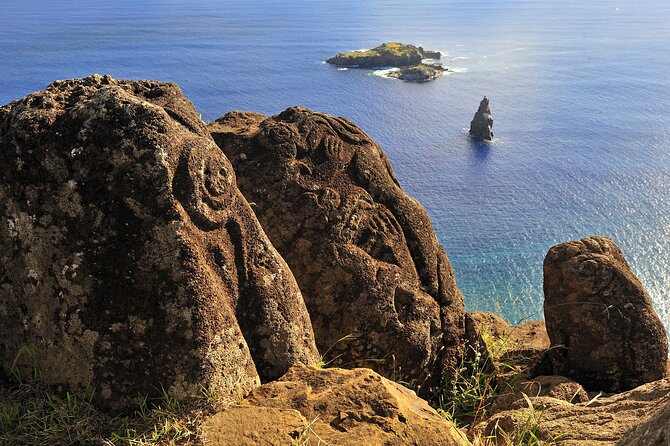
Orongo is the most dramatic historical stop of the day, set near Rano Kau and tied to the Tangata Manu, or birdman, competition.
The ceremony honored Make Make, the creator god. Representatives of rival clans descended the cliff, swam to Motu Nui, and waited for the first seasonal seabird egg. The representative who secured it returned as the tangata manu, gaining rights and privileges over competing groups.
The ritual developed after the older political and religious order had lost authority. In that sense, Orongo is not only a ceremonial village. It records a contest for power between opposing clans.
The site’s houses were built for the competition, with the first structures dating to around 1400 AD. More than 1,700 petroglyphs surround the village, giving Orongo the highest concentration of rock art on the island.
You spend about an hour here, and admission is included. The time is well used, since the story depends on seeing the cliff, the offshore islets, and the carved symbols together. Stay aware of the conditions at the edge and listen to your guide’s explanation of how the ceremony worked.
What $200 per person really buys
At $200 per person, this is not the cheapest way to see Easter Island. The price makes more sense if you are traveling as a couple, family, or small group and want private transport rather than a shared excursion.
You are paying for an accredited local guide, hotel pickup and drop-off, an air-conditioned vehicle, bottled water, and a route that covers seven major locations. You also gain the ability to adjust the plan.
That flexibility is not a minor extra. Joaquin has changed the route when people had already visited some sites independently, taking them to different moai locations instead of making them repeat the same stops. If you have extra days on Rapa Nui or have already seen Tahai, tell the provider before the tour.
Group discounts may be available, which can improve the value for larger private parties. The tour is offered in English, and only your group participates.
The tradeoff is that the day is tightly packed. You see a great deal, but each stop has a clock. If you prefer long walks, extended photography, or unhurried meals, a private custom day with fewer sites may suit you better.
Who should book this tour
I would choose this experience if you have one main sightseeing day and want the island’s essential sites handled in one route. It is particularly well suited to first-time visitors who want context rather than a quick series of photo stops.
It also works well for people who dislike large groups. The private format lets you ask questions without waiting for a busload of people, and it gives Joaquin room to adapt the day.
The tour is less suitable if your main aim is a beach day, a long hike, or a low-cost independent outing. It is also not available for cruise ship passengers, so you need to be staying on Easter Island and using a hotel pickup.
Confirmation arrives within 48 hours, subject to availability. Free cancellation is allowed up to 24 hours before the start time. Since the experience depends on good weather, a weather cancellation results in another date or a full refund.
Should you book the Highlights of Easter Island?
Book it if you want to see Anakena, Tongariki, Rano Kau, Ahu Akivi, Rano Raraku, Tahai, and Orongo in one private day, with a guide who can explain what you are seeing and adjust the route when needed.
The strongest reasons are Joaquin’s flexibility, the excellent spread of sites, and the long visit at Rano Raraku. The price is fair for private service, but not a bargain. Confirm the pickup time, national park fee, and any route changes before you go.
For a first visit with limited time, I would book it. If you have several days and enjoy planning your own route, you may prefer to arrange individual outings and spend longer at fewer places.
FAQ
How long does the private Easter Island tour last?
The tour lasts approximately seven hours, including transportation between the seven stops.
What time does pickup begin?
The stated start time is 9:00 a.m., but pickup is generally around 9:30 a.m. unless a different time is agreed upon. Pickup is from your hotel on Easter Island.
Is the tour private?
Yes. Only your group participates, and the experience includes a private, personalized itinerary.
Is lunch included?
No. Lunch is not included, so plan accordingly for this full-day outing.
Is the national park fee included?
No. The national park fee is listed separately from the included tour services.
Can cruise ship passengers book this experience?
No. This tour is not available for cruise ship passengers.
Just added around Hanga Roa
- Volcanic Refuges: Excursion to Underground Civilization★ 4.7 · 8 reviews
- Easter Island Ancestral Dinner and Show with Transport★ 4.5 · 2 reviews
- Volcanic Wonders and the Kingdom of the Birdman: Half Day★ 5.0 · 6 reviews
- Half Day Private Tour: Caves and Volcanic Refuges★ 4.0 · 14 reviews
- Tour to the Motus: Boat trip and snorkeling in Rapa Nui★ 5.0 · 8 reviews
- Visit Rapa Nui in 4 days with 3 Tours and Accommodation included★ 4.0 · 2 reviews
- Birdman Ceremonial Route: Orongo, Ranu Kau Half-Day Tour★ 4.5 · 16 reviews
- Private Tour: Tongariki Sunrise Experience★ 4.5 · 20 reviews
Easter Island Tours, compared.
Two days of Full Day Tour of Rapa Nui + Sunrise in Tongariki
Read our review →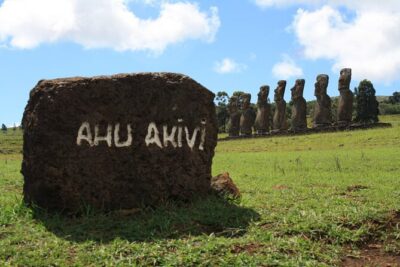
2-Day Private Tour Easter Island Highlights Complete Discovery
Read our review →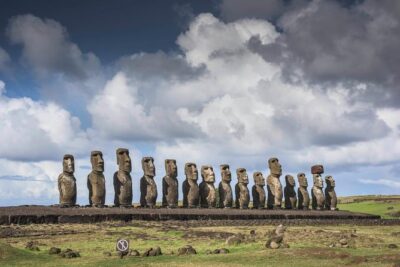
Private Tour: Full Day Easter Island Highlights
Read our review →
Browse the lists this tour appears in