
Reviewed · EASTER ISLAND TOURS
Full Day Tour in Rapa Nui
The island’s story is written in stone. This six-hour outing gives you six important Rapa Nui sites, from the seven Moai at Ahu Akivi to the Birdman village of Orongo. I like the strong mix of archaeology and scenery, and I appreciate the chance to visit caves, a volcanic crater, and a red-stone quarry in one day. The main concern is that the day can feel shorter than advertised, especially if pickup delays, bilingual explanations, or a slow cave visit eat into the schedule.
At $70 per person, the tour is a sensible introduction to the western and central parts of Rapa Nui, provided you understand what it does not cover. It does not include the famous fifteen-statue platform at Ahu Tongariki or the main Moai quarry at Rano Raraku. The National Park ticket costs extra, and you should arrange it before setting out.
In This Review
- The six things to know before booking
- What this $70 Rapa Nui tour really covers
- Ahu Akivi and the seven Moai facing the sea
- Ana Te Pahu, the cave stop that requires care
- Puna Pau and the red stone above the statues
- Ahu Vinapu and the island’s unusual stonework
- Rano Kau, a crater with room to breathe
- Orongo and the Birdman competition
- Guides, languages, and the pace of the day
- Food, water, park tickets, and physical effort
- Is six hours enough for Rapa Nui?
- Who should book this route?
- Should you book Full Day Tour in Rapa Nui?
- FAQ
- What is included in the Rapa Nui tour?
- How long does the tour last?
- What sites does the tour visit?
- Does the tour visit Ahu Tongariki or Rano Raraku?
- Is the National Park ticket included?
- How many people can join?
- Is the tour suitable for people with average fitness?
- What should I bring?
The six things to know before booking
- Ahu Akivi is the only listed stop with a group of seven Moai, so this is not the best choice if your main goal is to see many statue platforms.
- Ana Te Pahu takes about 90 minutes, and the cave can be dark, wet, slippery, and low inside. Bring a phone light and shoes with a firm grip.
- Orongo and Rano Kau provide the tour’s strongest setting, combining a huge volcanic crater with the dramatic story of the Birdman competition.
- Puna Pau explains the Moai topknots, which were made from red volcanic scoria found at this quarry.
- The advertised maximum is 14 people, but group size and vehicle arrangements should be confirmed before departure.
- Bring water, food, sun protection, and your park ticket, since snacks and drinks are not reliably supplied and admission is not included.
What this $70 Rapa Nui tour really covers
The tour begins at about 9:30 a.m. in Hanga Roa and lasts roughly six hours. Transportation and a guide are included, with a stated maximum of 14 people. That small-group limit could make the day more personal, though the actual experience may depend on the departure, language mix, and whether the guide is also driving.
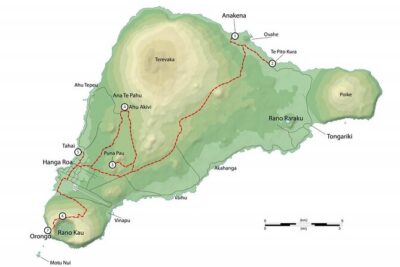
The route covers six sites, but it is better understood as one half of a two-day Rapa Nui program rather than a complete survey of the island. This matters. If you have only one day, you may want a route focused on Ahu Tongariki and Rano Raraku, the places most often pictured in brochures. If you have two days, this western and central circuit gives you a useful second layer of the island’s story.
The tour’s best quality is variety. You are not simply moving from one Moai platform to another. You see a ceremonial platform, a cave system, a quarry for statue topknots, unusual stonework, a crater, and the center of the Birdman tradition. That gives you a wider view of Rapa Nui culture than a statue-only outing.
The weak point is time. A few departures have finished around 2 p.m. or 3 p.m., despite being sold as a full-day experience. Pickup complications have also caused long delays in some cases. I would treat the six hours as an approximate target, not a promise that you will spend a full morning and afternoon in the park.
More Rapa Nui trips and moai walks:
- From Hanga Roa: Rapa Nui Culture Sightseeing Tour
★ 4.6 · 307 reviews - From Hanga Roa: Easter Island Highlights 2-Day Tour
★ 4.3 · 205 reviews - 2-Day Private Tour Easter Island Highlights Complete Discovery
★ 5.0 · 110 reviews
Ahu Akivi and the seven Moai facing the sea
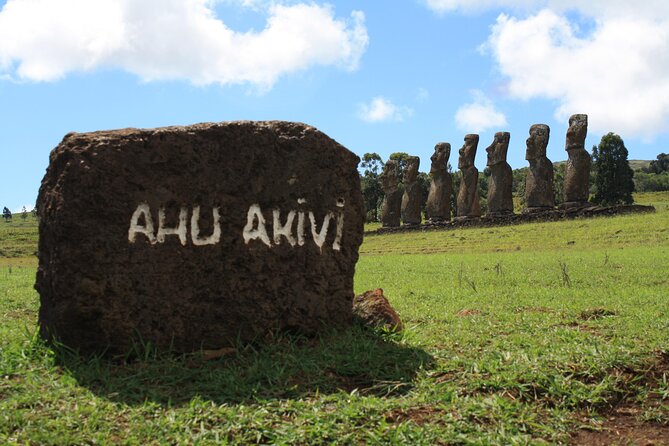
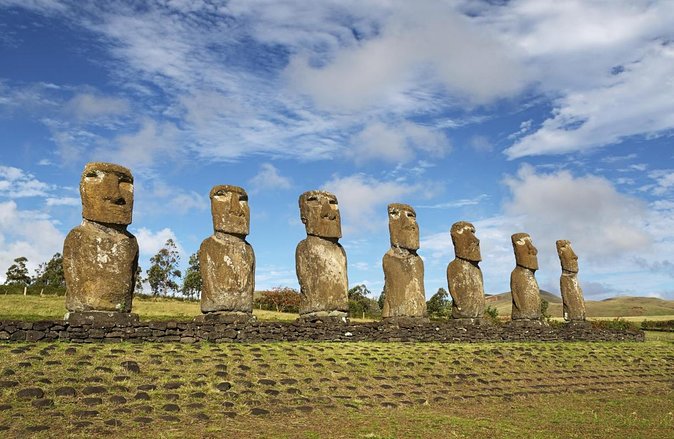
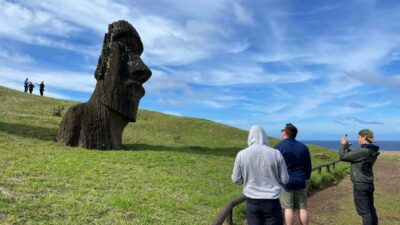
Ahu Akivi is a fine opening stop because its seven Moai create an immediate sense of scale. The statues face toward the ocean, an unusual arrangement on Rapa Nui, where many ceremonial platforms have statues looking inland across the island.
You get about 45 minutes here. That is enough to see the platform, take photographs, and hear the basic explanation of the statues and their place in Rapa Nui culture. It is not a long, slow visit, so listen closely while the guide speaks.
The site also helps correct a common expectation. This tour gives you seven Moai at Ahu Akivi, not a long line of statues like the fifteen at Ahu Tongariki. If your dream image of Rapa Nui includes a broad row of restored figures, you will need a different tour or another day.
I like Ahu Akivi because the setting feels open and uncluttered. You can focus on the statues and the question of why they face the sea. For a first stop, it offers a clear introduction to ceremonial platforms without overwhelming you with too much information at once.
Ana Te Pahu, the cave stop that requires care
Ana Te Pahu is the longest stop, at about an hour and a half. The route passes through green surroundings and older palm growth before reaching a network of lava caves used by the Rapa Nui people for different purposes.
This is the most physically demanding part of the outing. The interior can be dark, with water on the floor, low ceilings, and slippery sections. Some people have had to rely on cell phone lights, and not every departure has provided a torch or a clear warning about the conditions.
You should wear stable walking shoes and carry your own light. A walking stick can also help if you are unsteady, but do not assume the cave is a simple stroll. You need a moderate level of fitness, and anyone uncomfortable in dark, enclosed spaces may prefer to spend less time inside.
The cave has real value when the guide explains how volcanic spaces fit into island life. Without that context, it can feel like a long walk through a dark passage. With a good guide, the cool underground setting becomes a useful way to understand how people adapted to Rapa Nui’s volcanic terrain.
Weather can affect this stop. If conditions make the cave unsafe, the route may change. That is sensible, but it also means you should not book this tour solely for Ana Te Pahu.
Puna Pau and the red stone above the statues
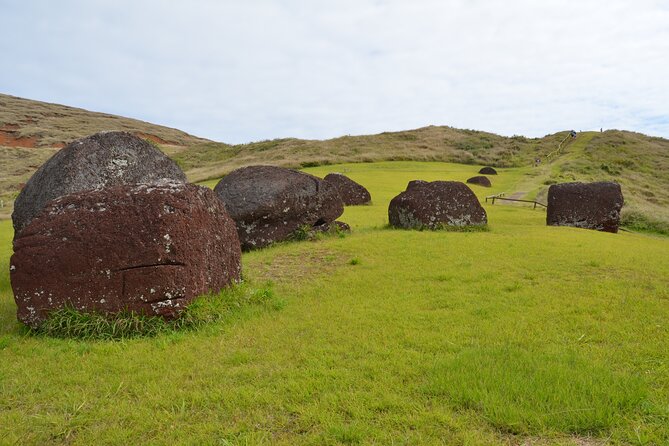
Puna Pau is a 45-minute stop at the quarry where the red volcanic stone for the Moai topknots, or pukao, was extracted. The red scoria here is different from the stone used for the statues themselves, so this stop explains an important part of the construction process.
The site is less instantly dramatic than a row of Moai, but it answers a question many people have after seeing the statues: where did those heavy red cylinders come from? The guide can explain the stone’s symbolic role and how it completed the appearance of the figures.
I find this stop especially useful for putting the Moai into practical terms. Rapa Nui society was not only creating enormous stone figures. It was sourcing different materials and moving them across difficult ground. Puna Pau gives you a glimpse of that planning and labor.
The drawback is that the stop is brief and admission is not included. If you want a long walk around the quarry, the schedule may feel tight. Still, it is a worthwhile stop for anyone curious about how the statues were finished.
A few more Hanga Roa trips worth comparing side by side
- Private Full-Day Easter Island Highlights North and West
★ 5.0 · 84 reviews - Full Day Private Tour: Factory of the Moai the stone giants
★ 4.5 · 63 reviews - Private Easter Island Full-Day Tour
★ 5.0 · 61 reviews - Private Full-Day Easter Island Highlights South and East
★ 5.0 · 60 reviews
Ahu Vinapu and the island’s unusual stonework
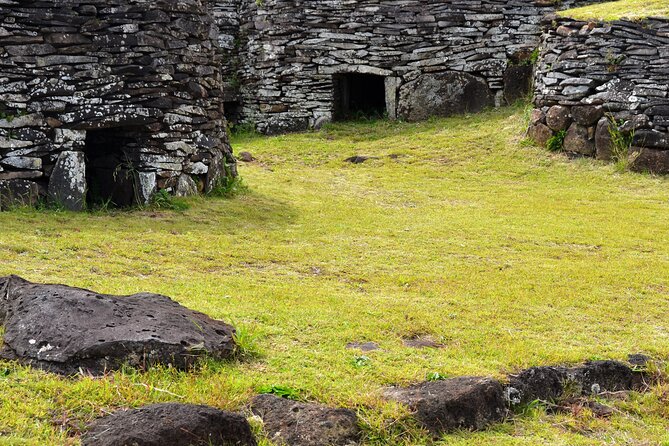
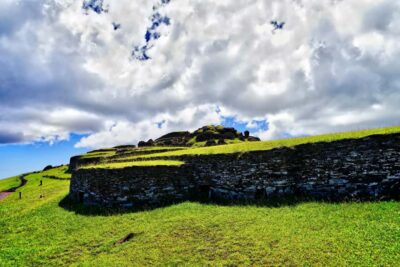
At Ahu Vinapu, the focus shifts from statue-making to construction. The site has large, carefully fitted stones that have often been compared with Inca stonework in South America.
The comparison is intriguing, but it should be handled carefully. The attraction here is the precision of the stone construction and the questions it raises about contact, influence, and independent development. A good guide will help you consider those ideas without presenting every theory as settled fact.
You have about 45 minutes. That is enough to examine the stonework and hear the main explanation, though not enough for a leisurely archaeological study. Vinapu is also a reminder that Rapa Nui culture cannot be reduced to the Moai. The ceremonial platforms and engineering behind them deserve attention too.
For some people, this will be a quieter stop. If you want constant statue views, it may seem less exciting. I would see it as a change of pace that adds architectural context to the day.
Rano Kau, a crater with room to breathe
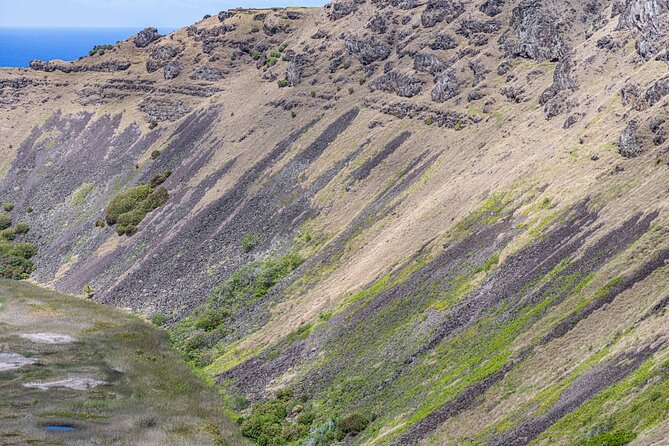
Rano Kau is the shortest listed stop at about 30 minutes, but it may give you the most memorable view. From the rim, you look into a huge volcanic crater with a lake and plant-covered inner slopes.
The crater provides a useful pause after the cave and archaeological sites. You can take in the scale of the volcano, photograph the interior, and understand how volcanic activity shaped the island. The view is broad and easy to appreciate even if you are not deeply interested in geology.
Because the stop is short, stay alert when the guide begins the explanation. There may be little time to wander. The tour may also make an extra viewpoint stop for photographs when conditions and timing allow, but that should be treated as a bonus, not a guaranteed part of the route.
Rano Kau and Orongo are close together, yet they offer different experiences. Rano Kau is about the physical setting. Orongo is about the people who used that setting for ceremony and competition.
Orongo and the Birdman competition
Orongo receives about 75 minutes and is one of the strongest parts of the day. The ceremonial village sits near the edge of Rano Kau, with the Pacific stretching out beyond it.
Here you learn about the Birdman competition, a major ritual in which contestants competed for status and authority. The site includes stone structures, ceremonial areas, and petroglyphs. Its position above the sea makes the setting feel dramatic without needing much decoration.
This is where the tour’s cultural focus is at its best. A guide can connect the village, the crater, the offshore islets, and the annual contest into one clear story. Several guides have been praised for patient explanations and for answering many questions, including Merahi, Frank, Zoe, Enzo, Fernanda, Nicolas, Enrique, and Sol.
Access around Orongo can change. A landslide recently shortened some visits, with explanations continuing in the visitor center instead. That is another reason to value a guide who can provide context even when weather or safety rules alter the walking route.
If you have to choose one stop where you want extra attention, choose Orongo. It combines scenery, archaeology, and living cultural memory better than any other place on this itinerary.
Guides, languages, and the pace of the day
The guide can make or break this experience. The strongest departures have included local guides who explain Rapa Nui culture with warmth, patience, and detail. A native Rapa Nui guide who speaks fluent English can add a personal connection that a printed description cannot provide.
But language arrangements are not always simple. English and Spanish may be combined, with every explanation repeated in both languages. That can reduce the time available at each site. In some cases, the guide also drives, which means little or no commentary while the vehicle is moving.
I would ask at booking whether the departure is English-only or bilingual, and whether the guide and driver are separate people. That question matters more here than on a simple transfer. The island’s sites are spread out, and the driving time is part of the educational value.
You should also expect a fairly brisk schedule. Some stops last only 30 or 45 minutes, and Ana Te Pahu uses a large portion of the day. A clear guide should tell you the order of the stops, walking conditions, restroom opportunities, and meal plan at the beginning. That basic orientation has not always been consistent.
Food, water, park tickets, and physical effort
Pack for the whole outing. Water and snacks are not reliably provided, despite some conflicting descriptions, and you may go several hours before the next toilet stop. Bring more water than you think you need, along with a snack or packed lunch.
The National Park ticket is not included in the $70 price. You may need to purchase it before the tour rather than simply paying at the first site, so handle that in advance. Without the ticket, you risk losing time at the entrance or being unable to enter the protected areas.
Comfortable walking shoes are essential for Ana Te Pahu and useful everywhere else. Sun protection is also practical, since several stops are open and exposed. The activity calls for moderate physical fitness, and that description is fair, especially because the cave may involve uneven, wet ground and low ceilings.
Pickup begins around 9:30 a.m., but reported pickup times have sometimes shifted later. Confirm the meeting point and time directly, particularly if you are staying somewhere outside central Hanga Roa or have a flight, cruise departure, or other fixed plan.
Is six hours enough for Rapa Nui?
Six hours is enough to understand a major section of the island, not enough to see everything. You will visit six sites, but the stops are spread across different themes rather than concentrated around the most famous statue groups.
The route works well as a first or second day. It is particularly useful if you want to understand the Birdman tradition, volcanic geology, caves, and the making of the Moai topknots. It works less well if you have only one day and want the largest number of iconic statues.
The price is fair for guided transport across a remote island, especially if your group stays near the advertised 14-person limit and the guide provides strong interpretation. The value drops if pickup problems cut the outing to four hours, if a driver has to translate and guide at once, or if you expected lunch and refreshments to be included.
I would leave room after the tour rather than planning another major activity immediately afterward. Some departures return well before evening, but the timing has been inconsistent. That flexibility protects you from both an early finish and a delayed start.
Who should book this route?
I would recommend it to you if you want a broad introduction to Rapa Nui beyond the postcard Moai. It suits people who enjoy cultural explanation, volcanic scenery, and a little physical challenge, especially if you have a second day for the island’s more famous eastern sites.
Families can enjoy the variety, but parents should judge whether children are comfortable with a dark cave and uneven ground. Older adults can still have a good day, though Ana Te Pahu deserves an honest assessment of mobility and balance.
Solo visitors may appreciate the small-group setting and the chance to ask questions. Couples and families should confirm the language arrangement if detailed English interpretation is important.
I would not choose this as your only Rapa Nui tour if Ahu Tongariki, Rano Raraku, or the main statue quarry are your priorities. Those places are not part of this route. Choose a different circuit, or add a second tour.
Should you book Full Day Tour in Rapa Nui?
Book it if you want Ahu Akivi, Ana Te Pahu, Puna Pau, Vinapu, Rano Kau, and Orongo in one guided outing, and you are prepared for a brisk, sometimes changeable schedule. The best guides bring the island’s culture to life, with Orongo and the crater providing the day’s strongest combination of meaning and scenery.
Skip it if you expect a long day packed with famous Moai rows, included food, or perfectly precise timing. Before paying, confirm the pickup details, language, group size, park ticket requirement, and whether the cave is open.
Free cancellation is available up to 24 hours before the start time. That gives you some protection while planning, but changes or cancellations made inside that window are not accepted for a refund.
FAQ
What is included in the Rapa Nui tour?
Transportation and a guide are included. Food, drinks, and the National Park ticket are not included.
How long does the tour last?
The stated duration is approximately six hours, beginning around 9:30 a.m. Actual return times can vary.
What sites does the tour visit?
The route includes Ahu Akivi, Ana Te Pahu, Puna Pau, Ahu Vinapu, Rano Kau, and Orongo.
Does the tour visit Ahu Tongariki or Rano Raraku?
No. The listed route does not include the fifteen Moai at Ahu Tongariki or the main Moai quarry at Rano Raraku.
Is the National Park ticket included?
No. The park ticket must be purchased separately, and it may need to be arranged before the tour.
How many people can join?
The stated maximum is 14 people. Confirm the group size when booking, since vehicle arrangements can vary.
Is the tour suitable for people with average fitness?
The activity calls for a moderate physical fitness level. Ana Te Pahu can include dark, wet, slippery areas, low ceilings, and uneven ground.
What should I bring?
Bring water, snacks or a packed lunch, sun protection, suitable walking shoes, and a phone or flashlight for the cave. Also arrange your National Park ticket before departure.
Just added around Hanga Roa
- Volcanic Refuges: Excursion to Underground Civilization★ 4.7 · 8 reviews
- Easter Island Ancestral Dinner and Show with Transport★ 4.5 · 2 reviews
- Volcanic Wonders and the Kingdom of the Birdman: Half Day★ 5.0 · 6 reviews
- Half Day Private Tour: Caves and Volcanic Refuges★ 4.0 · 14 reviews
- Tour to the Motus: Boat trip and snorkeling in Rapa Nui★ 5.0 · 8 reviews
- Birdman Ceremonial Route: Orongo, Ranu Kau Half-Day Tour★ 4.5 · 16 reviews
- Visit Rapa Nui in 4 days with 3 Tours and Accommodation included★ 4.0 · 2 reviews
- Private Tour: Tongariki Sunrise Experience★ 4.5 · 20 reviews
Easter Island Tours, compared.
Two days of Full Day Tour of Rapa Nui + Sunrise in Tongariki
Read our review →
2-Day Private Tour Easter Island Highlights Complete Discovery
Read our review →
Private Tour: Full Day Easter Island Highlights
Read our review →
Private Full-Day Easter Island Highlights North and West
Read our review →Browse the lists this tour appears in