
Reviewed · EASTER ISLAND TOURS
Easter Island 2 Half Days and 2 Full Days Private Trekking Tour
Moai, volcanoes, caves, and one great sunrise. This four-day private tour gives you a strong introduction to Rapa Nui, from the restored statues at Ahu Tahai to the fifteen moai at Tongariki and the quarry where many were made. I like the private transport and the way the route includes both famous sites and quieter archaeological places. I also like that breakfast, lunch, water, and an English-speaking guide are included.
The main drawback is cost: $934 per person is a serious investment, and the mandatory National Park ticket adds another $100. Accommodation is not included, and the tour requires a moderate level of fitness, especially during the cave visits and long sightseeing days.
The guide can make a real difference here. Toto is praised for his clear explanations, good photo stops, and quick help when one guest hurt a knee. He even arranged an ice pack and walking stick and served fresh pineapple juice from his farm. If you book, you can ask if Toto is available.
In This Review
- Key points to know before booking
- Why this private four-day plan works
- Day one: Tahai, Rano Kau, Orongo, and Vinapu
- Day two: the great moai circuit
- Day three: red stone, seven moai, and four caves
- Day four: sunrise behind the moai at Tongariki
- What the $934 price includes, and what it does not
- Guide quality and the private experience
- Who should book this tour?
- FAQ
- How long does the Easter Island tour last?
- Is hotel pickup included?
- Is the National Park ticket included?
- Is accommodation included?
- Is transportation included?
- What meals are included?
- Does the tour visit Ahu Tongariki more than once?
- Is the tour suitable for every fitness level?
- Should you book it?
Key points to know before booking
- Ahu Tongariki gets two visits: You see the great fifteen-moai platform during the main island circuit, then return for a four-hour sunrise outing.
- The private format keeps the pace flexible: Only your group takes part, with hotel pickup and private transportation around the island.
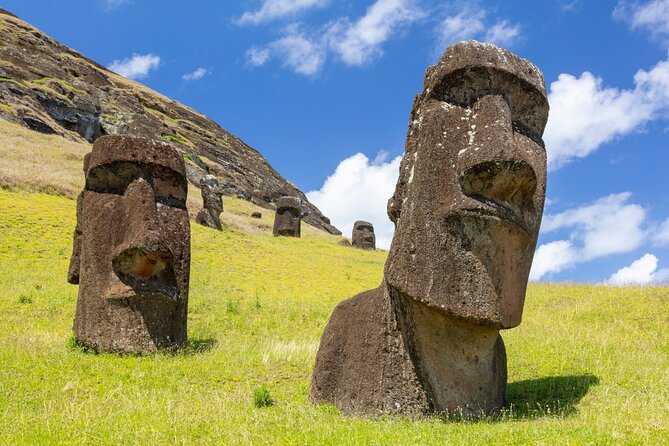
- Rano Raraku explains the moai better than any museum: You see the quarry where the statues were carved and prepared for transport.
- Day three is the most active: Puna Pau, Ahu Akivi, and four cave sites make this a full day of walking and exploration.
- The National Park ticket costs extra: It is mandatory, costs $100 per person, and remains valid for ten days from first entry.
- Meals simplify a remote-island schedule: Breakfast, lunch, and water are included, while your hotel must be booked separately.
Why this private four-day plan works
Easter Island is compact on a map, but its major sites are scattered across the coast, volcanic slopes, and interior roads. This tour groups the sights into four well-defined days, giving you time to see the major moai platforms without arranging separate rides.
The private setup is a real advantage. You are not tied to a large group’s pace, and the guide can give more attention to questions, photographs, and practical needs. That mattered when Toto helped a guest with a knee problem. It also means you can ask for a little more time at an important site rather than being rushed through every stop.
The schedule combines two half days and two full days. Day one is focused on the southwest and nearby ceremonial sites. Day two is the classic east coast and north coast route. Day three covers the interior and northwest, with several caves. Day four is reserved for sunrise at Tongariki.
That structure is useful because the island’s main sites are not treated as a single exhausting loop. You return to some of the most important places at different times, including Tongariki in both daylight and early morning.
More Private Tours in Easter Island
- 2-Day Private Tour Easter Island Highlights Complete Discovery
★ 5.0 · 110 reviews - Private Tour: Full Day Easter Island Highlights
★ 5.0 · 106 reviews - Private Full-Day Easter Island Highlights North and West
★ 5.0 · 84 reviews
Day one: Tahai, Rano Kau, Orongo, and Vinapu
Your first stop is Ahu Tahai, a ceremonial complex close to Hanga Roa. It includes three ahu, or ceremonial platforms: Ko Te Riku, Tahai, and Vai Ure. Ko Te Riku is especially memorable because its moai has restored eyes, giving the statue a more human presence than many others on the island.
Tahai is also a practical first stop. Its closeness to town makes it easy to reach, and it is known as a popular sunset photography site. The one-hour visit gives you time to look across all three platforms instead of treating the area as a quick photo stop.
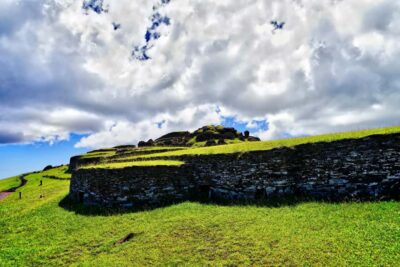
The route then heads to Orongo, one of Rapa Nui’s most important archaeological places. The village sits beside the crater of Rano Kau and is tied to the Birdman ceremony, a competition that shaped political and religious life on the island.
Allowing two hours here is sensible. Orongo is not simply a row of statues. The setting, the stone houses, and the views toward the volcanic crater all need time to make sense. Your guide’s explanations are particularly useful because the ceremonial importance of the site is not obvious from the ruins alone.
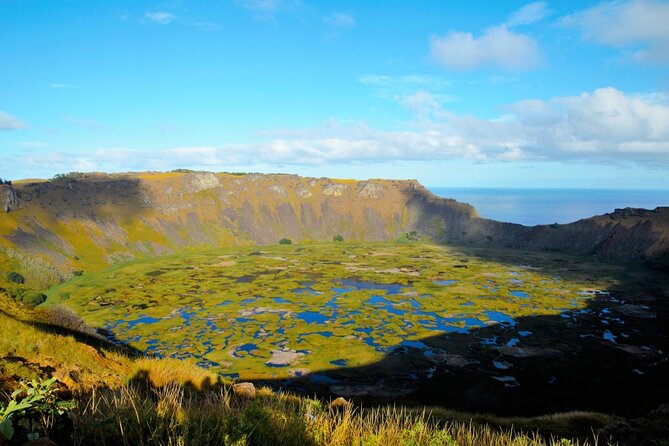
Rano Kau is next, with about thirty minutes set aside for the crater. Its interior is roughly 1.5 kilometers across, and the crater lake once served as an important source of drinking water. The area also protects much of Rapa Nui’s endemic plant life.
This stop is mainly about the scale of the volcano and the unusual sight of a lake inside the crater. It is a short visit, so you should think of it as a scenic pause connected to Orongo rather than a separate long walk.
The final stop is Ahu Vinapu. Its precisely fitted stonework has often drawn comparisons with Inca construction. The site offers a useful contrast with the restored platforms elsewhere because it makes you pay attention to the masonry itself, not only to the moai.
Admission is not included at the day one sites, and the National Park ticket must be purchased separately. That ticket is valid for ten days from your first entry and covers all park sites, so you pay once rather than at every stop.
Day two: the great moai circuit
Day two is the tour’s main full-day outing, with five important sites and about five and a half hours of listed sightseeing time. Ahu Akahanga begins the day on the southeast coast.
Akahanga helps you understand how an old Rapa Nui settlement related to its ceremonial platform. Several fallen moai remain on the ground, lying on their backs or faces. It is a less polished sight than the restored platforms, but that is part of its value. You see the archaeological site in a state that communicates conflict, abandonment, and change.
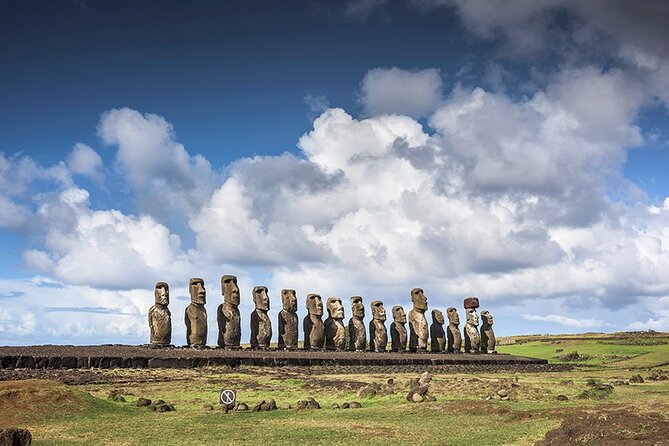
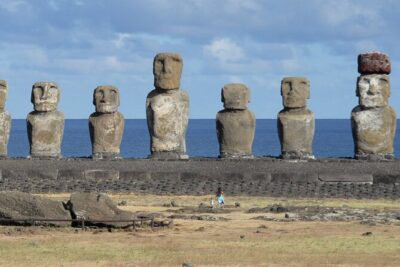
Ahu Tongariki is the visual centerpiece. Its fifteen moai form the largest reconstructed platform on the island, with the statues facing inland and their backs toward the Pacific. The platform is wide and imposing, but the setting opposite Rano Raraku adds even more meaning. The next stop shows where the statues came from.
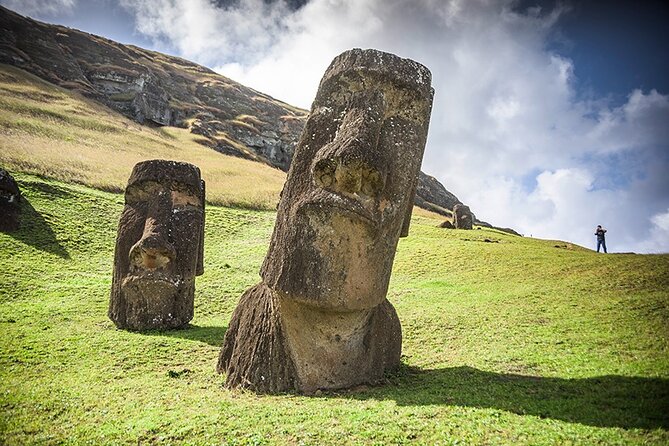
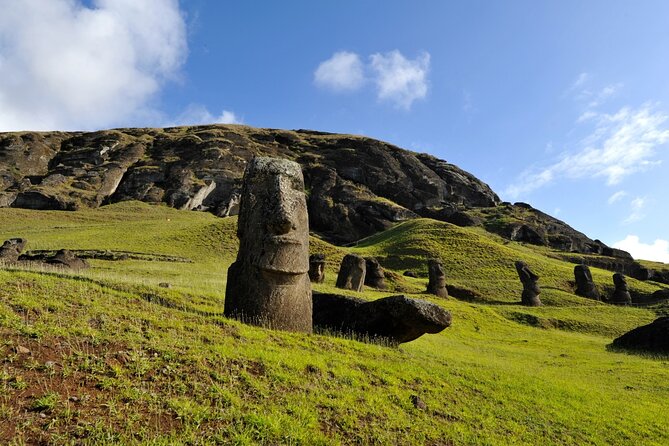
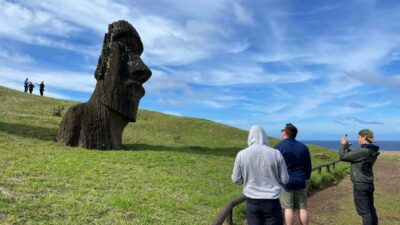
Rano Raraku is the only volcanic tuff quarry on Easter Island. Tuff is the soft volcanic material used for carving many moai, and the slopes still contain statues at different stages of completion. Two hours here is one of the strongest parts of the itinerary.
I like this stop because it changes the way you see every other statue. At the quarry, the moai are not only finished monuments. You can think about carving, shaping, moving, and placing them on distant ahu. The guide can connect the unfinished figures to the platforms you have already seen.
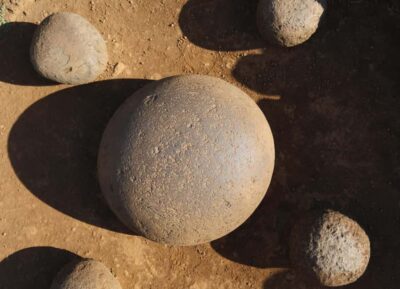
Ahu Te Pito Kura follows with Ahu o Paro, the largest moai transported from Rano Raraku. It measures about 11 meters and weighs roughly 90 tons. Nearby is the rounded stone called Te Pito o te Henua, which local tradition says was brought by the island’s ancestors.
The stop is only thirty minutes, so the visit is brief. Still, the scale of Ahu o Paro makes it worthwhile, especially after Rano Raraku has shown you the quarrying process.
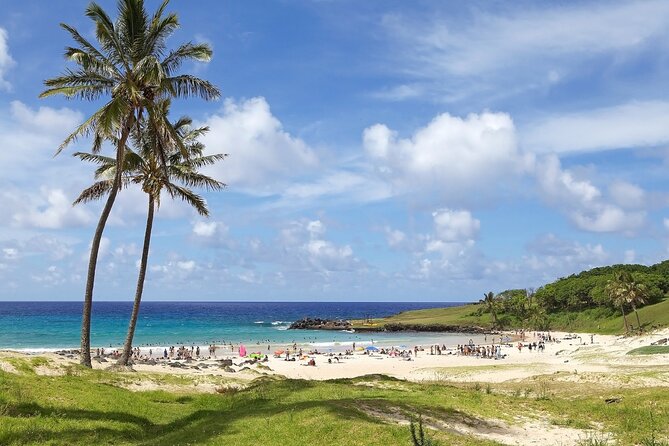
The day ends at Anakena Beach, the island’s main beach. Warm turquoise water and coral sand make it a welcome change from the stone platforms and volcanic ground. Anakena also has cultural importance as the ancestral residence of the Miru Araki royal family.
The Ahu Nau Nau platform here is known for the fine quality of its moai. This is a good place to let the day slow down, although the hour-long stop may feel short if you want plenty of time for both the beach and the archaeological site.
Day three: red stone, seven moai, and four caves
Day three has six stops and is likely the most physically demanding part of the tour. The route begins at Puna Pau, the quarry for red volcanic stone used to make pukao, the cylindrical top pieces placed on some moai.
Twenty-three unfinished pukao can be seen here at an early stage of carving. The hill also gives you a privileged view over Hanga Roa. The half-hour visit is short, but it provides a useful companion to Rano Raraku. One quarry explains the moai bodies, while the other explains their red stone headpieces.
Ahu Akivi is unusual because it is one of the few ceremonial platforms away from the coast. Its seven moai have been restored to standing positions, and their astronomical alignment is part of the site’s appeal. They look toward the setting sun.
The stop lasts about thirty minutes, enough for the platform and an explanation of its orientation. It is a good reminder that Rapa Nui ceremonial sites were not placed only along the shoreline.
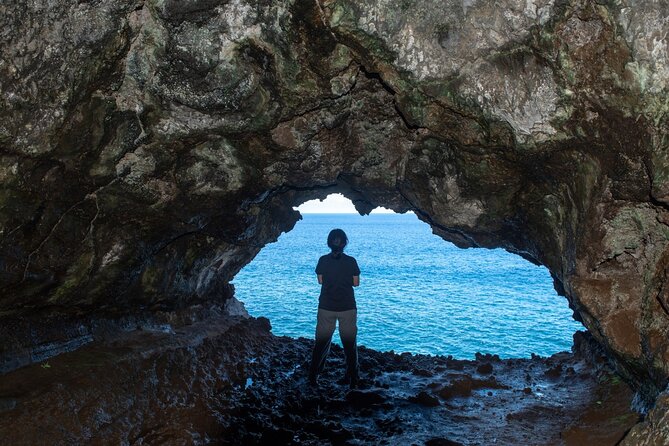
The day then turns to caves. Ana Te Pahu is the largest cave in Rapa Nui, formed by lava channels that connect four underground chambers. It was used as shelter and contains old umu, or cooking areas. Banana trees at the entrance explain its nickname, the cave of the bananas.
Ana Te Pahu gets an hour, and the extra time matters. The cave is not just a quick opening in the rock. Its underground chambers and signs of food preparation show how volcanic formations became useful parts of daily life.
Ahu Te Peu is an unrestored archaeological site. Fallen moai and the remains of a former settlement let you see the place without the clean lines of a reconstructed platform. The site once included a 43-meter-long hare paenga, a boat-shaped house, called Tore Tahuna in local tradition.
This stop may appeal most to you if you prefer archaeology over polished viewpoints. It asks you to look closely and use the guide’s explanations to picture the settlement that once occupied the area.
Ana Kakenga is a volcanic cave formed by lava flowing toward the sea. Two openings face the cliff, and the cave extends for about 50 meters. It once served as a kionga, or refuge.
Ana Pora is another volcanic cave, used as both shelter and a ceremonial place in ancient times. Its entrance is about 100 meters from the parking area, and the visit lasts about an hour.
The cave section makes this day different from the usual Easter Island highlights tour. It also explains the moderate fitness requirement. You should be comfortable with a full day of site visits and walking through uneven volcanic areas. The tour does not promise an easy sightseeing loop, so ask about current conditions if mobility is a concern.
More Rapa Nui trips and moai walks:
- From Hanga Roa: Rapa Nui Culture Sightseeing Tour
★ 4.6 · 307 reviews - From Hanga Roa: Easter Island Highlights 2-Day Tour
★ 4.3 · 205 reviews - From Hanga Roa: Easter Island Sightseeing Full Day Tour
★ 4.5 · 189 reviews - Two days of Full Day Tour of Rapa Nui + Sunrise in Tongariki
★ 4.5 · 132 reviews
Day four: sunrise behind the moai at Tongariki
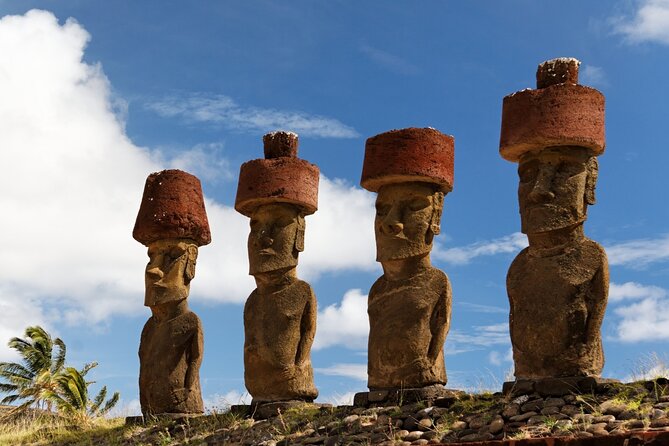
The final day is built around a four-hour sunrise visit to Ahu Tongariki. You have already seen the platform in daylight, but dawn gives it a different mood and helps justify the return trip.
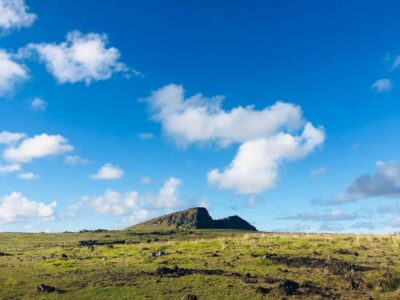
From October through March, the sun rises behind the platform during summertime. During the rest of the year, the sunrise comes from the direction of Poike volcano. Winter has a higher chance of unclear skies, so the view is weather-dependent.
The four-hour allowance is generous. It gives you time to arrive, wait for changing light, take photographs, and watch the statues shift from silhouettes to detailed stone figures. Since the exact sunrise quality cannot be guaranteed, the value of the visit is not only the perfect photograph. It is also the chance to see the island’s most imposing platform before the day’s activity begins.
You should ask the operator for the precise pickup time for your dates. The itinerary gives the duration, but not a fixed departure hour.
What the $934 price includes, and what it does not
At $934 per person, this is not a budget tour. The value depends on how much you want handled for you and how important private guiding is to your visit.
The price includes private transportation, a professional English-speaking guide, water, breakfast, and lunch. Hotel pickup is offered at accommodations across the island, provided you give the operator your hotel details. Group discounts may also reduce the per-person cost for larger parties.
The tour covers nearly every major archaeological site named in the schedule, plus several caves and the sunrise return to Tongariki. If you hired separate transport and guides for four days, the costs and planning time could add up quickly. The private format also gives you a practical safety net if someone in your group needs help, as shown by Toto’s quick response to the injured guest.
You must still budget for the $100 National Park ticket per person. Accommodation is not included, and the tour is not available to cruise ship passengers. Those details matter because the four-day format assumes you are staying on Easter Island rather than making a short port call.
Dietary restrictions such as vegetarian and vegan meals can be accommodated when you list them as special requirements at booking. That is useful on a schedule with long outings, since lunch is already part of the plan.
Guide quality and the private experience
The most strongly praised part of this experience is the guide service, especially Toto. He is credited with explaining the island’s history and background, finding good photo positions, and helping immediately when a guest hurt a knee.
Those details are more important than they may first appear. Easter Island’s sites can look simple at a glance: a platform, a few fallen statues, a crater, or a cave. A good guide connects the visible remains to how the settlement was arranged, how stone was worked, and why each place mattered.
The private format also gives you a chance to ask questions without competing with a large group. You can request Toto when booking, although availability is not guaranteed by the tour details.
Who should book this tour?
I would choose this tour if you want a single planned program covering the major moai sites, volcanic scenery, caves, and one sunrise. It suits couples, families, and small groups who value private transport and personal attention more than the lowest price.
It is also a good fit if you want help with photography, historical context, and the practical details of moving around a remote island. The fresh pineapple juice from Toto’s farm is a small but memorable touch, and it adds a local note to an otherwise tightly planned program.
I would think twice if your main goal is a cheap introduction, if you prefer to set your own pace every day, or if a moderate physical level is difficult for you. The National Park ticket and hotel costs also push the total well above the advertised tour price.
Free cancellation is available when you cancel at least 24 hours before the experience begins. Changes or cancellations made inside that window are not accepted for a refund.
FAQ
How long does the Easter Island tour last?
The experience lasts approximately four days and is arranged as two half days and two full days.
Is hotel pickup included?
Yes. Pickup is offered from hotels and other accommodations on Easter Island. You need to provide your hotel details when booking.
Is the National Park ticket included?
No. The mandatory National Park ticket costs $100 per person. It is valid for ten days from your first entry and covers all park sites.
Is accommodation included?
No. You must arrange and pay for your own accommodation on Easter Island.
Is transportation included?
Yes. Private transportation is included, and only your group participates in the activity.
What meals are included?
Breakfast, lunch, and water are included. Vegetarian and vegan dietary requirements can be accommodated if you provide them as special requirements when booking.
Does the tour visit Ahu Tongariki more than once?
Yes. Ahu Tongariki is included during the main island sightseeing day, and the tour returns there for a four-hour sunrise visit on day four.
Is the tour suitable for every fitness level?
The tour recommends a moderate physical fitness level. The schedule includes several cave visits and multiple full sightseeing days, so you should consider your comfort with walking and archaeological terrain before booking.
Should you book it?
Book this tour if you want Easter Island’s major sites arranged into one private, guide-led program and you are willing to pay for convenience and personal service. The strongest reasons are the wide site coverage, private transportation, included meals, and the chance to request Toto, whose care and photo guidance received especially high praise.
Skip it if the price feels too high after adding the National Park ticket and accommodation, or if you want a slower, self-directed visit. For a first trip to Rapa Nui, though, this is a well-planned way to see the moai, understand the quarries, visit the caves, and catch Tongariki at sunrise.
More Hiking Tours in Easter Island
- Poike: Full Day Hike
★ 5.0 · 4 reviews - Miru: The North Coast Full Day Hike
★ 5.0 · 2 reviews - Puerto Natales: Base of the Towers Day Hike
★ 4.8 · 727 reviews - From Santiago: Cajón del Maipo and Volcán San José Hike 8K
★ 4.9 · 418 reviews
Just added around Easter Island
- Volcanic Refuges: Excursion to Underground Civilization★ 4.7 · 8 reviews
- Easter Island Ancestral Dinner and Show with Transport★ 4.5 · 2 reviews
- Volcanic Wonders and the Kingdom of the Birdman: Half Day★ 5.0 · 6 reviews
- Half Day Private Tour: Caves and Volcanic Refuges★ 4.0 · 14 reviews
- Tour to the Motus: Boat trip and snorkeling in Rapa Nui★ 5.0 · 8 reviews
- Birdman Ceremonial Route: Orongo, Ranu Kau Half-Day Tour★ 4.5 · 16 reviews
- Visit Rapa Nui in 4 days with 3 Tours and Accommodation included★ 4.0 · 2 reviews
- Private Tour: Tongariki Sunrise Experience★ 4.5 · 20 reviews
Easter Island Tours, compared.
Two days of Full Day Tour of Rapa Nui + Sunrise in Tongariki
Read our review →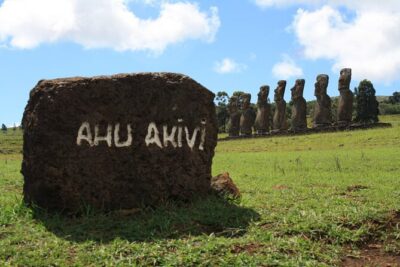
2-Day Private Tour Easter Island Highlights Complete Discovery
Read our review →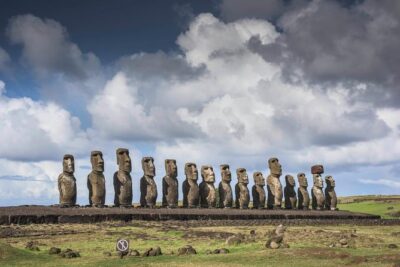
Private Tour: Full Day Easter Island Highlights
Read our review →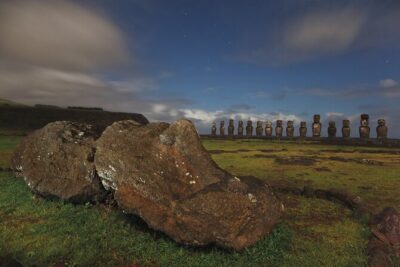
Browse the lists this tour appears in