
Reviewed · HISTORICAL TOURS
La Moneda Changing of Guard & Historic Santiago Walking Tour
Watch Santiago’s history march into view. This 2.5-hour walking tour links the Changing of the Guard at La Moneda Palace with the city center’s grand squares, old churches, colonial buildings, and Santa Lucía Hill. I like the guaranteed first-row position for the ceremony, and I like the small-group limit of 10 people, which gives the guide room to answer questions and explain Chile beyond the usual dates and façades.
The main consideration is pace. Several stops last only five minutes, so this is a guided overview rather than a slow architectural study. You will also be on foot for most of the morning, with the final climb at Santa Lucía Hill adding stairs and uneven ground.
In This Review
- Key details worth knowing before you book
- Why this tour works as a first look at Santiago
- Beginning at Citizenship Park and La Moneda Palace
- Constitution Square and Santiago’s political center
- Paseo Nueva York and the old commercial district
- Churches, Casa Colorada, and the road to Plaza de Armas
- Plaza de Armas and the Metropolitan Cathedral
- Finishing above the city at Santa Lucía Hill
- Is $39 a fair price?
- Who should book this walking tour?
- Practical details before you go
- FAQ
- How long is the La Moneda and historic Santiago tour?
- What time does the tour begin?
- Where does the tour start and finish?
- Is the Changing of the Guard included?
- How many people can join the tour?
- Is cancellation free?
- Should you book it?
Key details worth knowing before you book
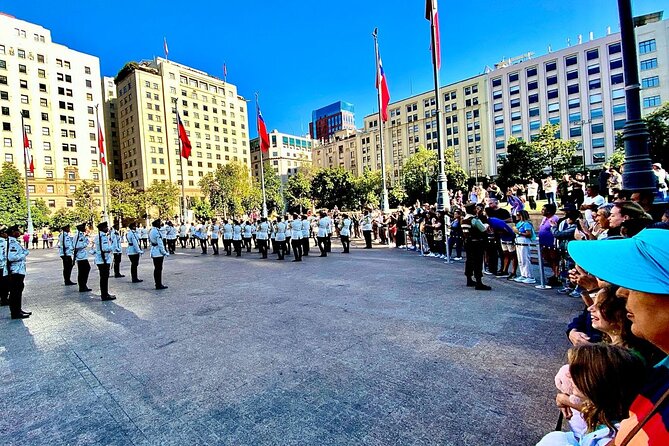
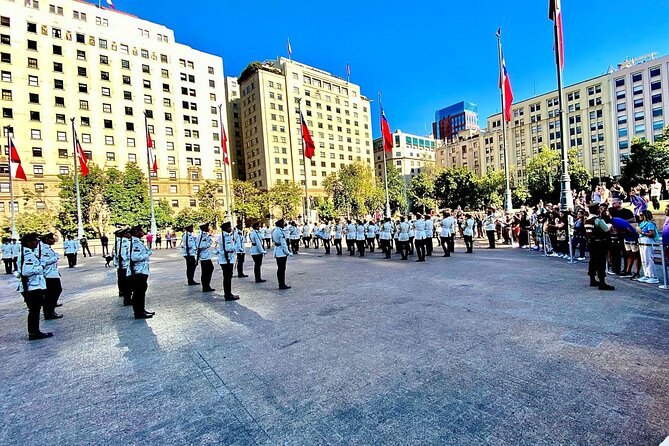
- The Changing of the Guard is the tour’s main event: You get a first-row view of the ceremony at La Moneda Palace, complete with uniforms, marching soldiers, and a live military band.
- The route covers Santiago’s historic core: You visit Plaza de la Constitución, Plaza de Armas, the Metropolitan Cathedral, old churches, colonial buildings, and major civic landmarks.
- The group is capped at 10 people: That is a useful limit for a walking tour, especially when you want to hear explanations in busy downtown areas.
- Santa Lucía Hill gives the tour a strong finish: The route ends at Neptune’s Terrace, with panoramic views and access to several transportation options.
- The meeting point is easy to identify: You begin at the Monument to General Bernardo O’Higgins Riquelme on Avenida Libertador Bernardo O’Higgins at 9:30 a.m.
- The price is $39 per person: Since the tour includes a local guide, the ceremony viewing position, and a full route through central Santiago, the value is strongest if you want an introduction to the city in one morning.
Why this tour works as a first look at Santiago
I see this experience as a useful first morning in Santiago. It begins with national ceremony and government buildings, moves through commercial and religious landmarks, then finishes above the city at Santa Lucía Hill. The route gives you a clear sense of how Santiago was founded, governed, rebuilt, and reshaped over time.
The tour is not built around paid museum admissions. Most stops are outdoor sights, public squares, churches, and historic streets. That keeps the price at $39 reasonable, but it also means you should not expect long visits inside every building or a major museum tour.
The route is led by a certified local expert guide. The tour is offered in English, and the guide information also lists Portuguese and Spanish. Two guides named in the feedback are Emmanuel and Ignacia. Emmanuel received praise for connecting the buildings with Chilean culture, its past, and its future. Ignacia was praised for her clear enthusiasm for the work. Those details matter because this route depends heavily on explanation. The buildings are attractive, but the guide is what turns a sequence of plazas into a story.
More History Tours in Santiago
- Santiago: Guided Walking Tour of the Historical Old Town
★ 4.8 · 459 reviews - Tour Viña Santa Rita: History, Wine and Picnic Outdoors
★ 4.5 · 141 reviews - Viña Del Mar and Valparaiso world heritage site.
★ 4.5 · 89 reviews
Beginning at Citizenship Park and La Moneda Palace
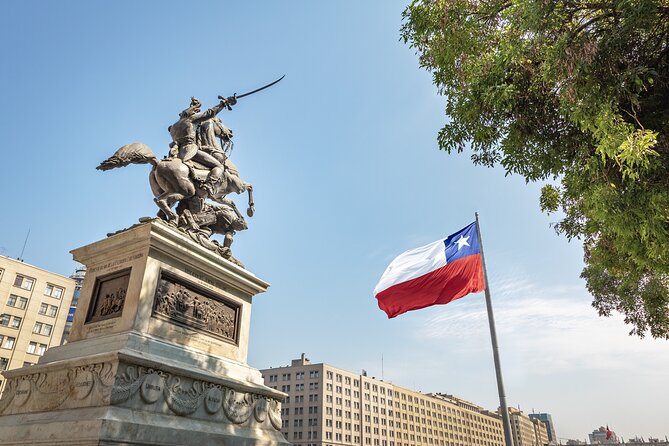
The tour starts at 9:30 a.m. beside the Monument to General Bernardo O’Higgins Riquelme. From there, you reach Plaza de la Ciudadanía, also called Citizenship Park, the broad civic space south of La Moneda Palace.
This plaza was redesigned in 2006 as part of Chile’s Bicentennial Project. Its features include long water mirrors, the monumental Bicentennial Flag, and the underground Centro Cultural La Moneda. The space also contains the Altar de la Patria, where the remains of Bernardo O’Higgins rest, along with statues honoring leaders of Chile’s independence.
You spend about five minutes here, so I would treat it as an orientation stop. The guide can point out the key symbols and explain why this wide, formal space matters. You will not have time for a full visit to the cultural center, but you will understand the civic setting before the main ceremony.
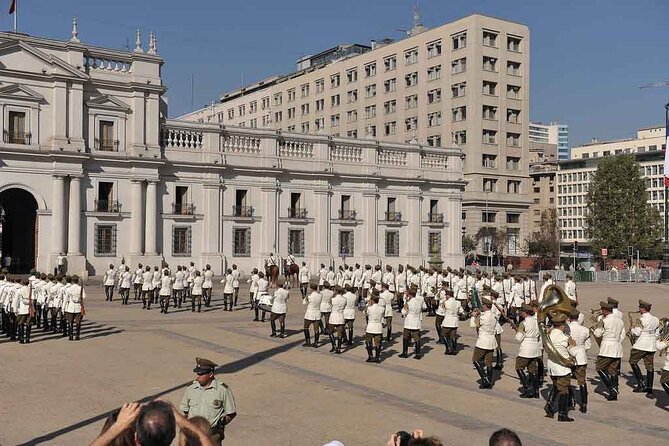
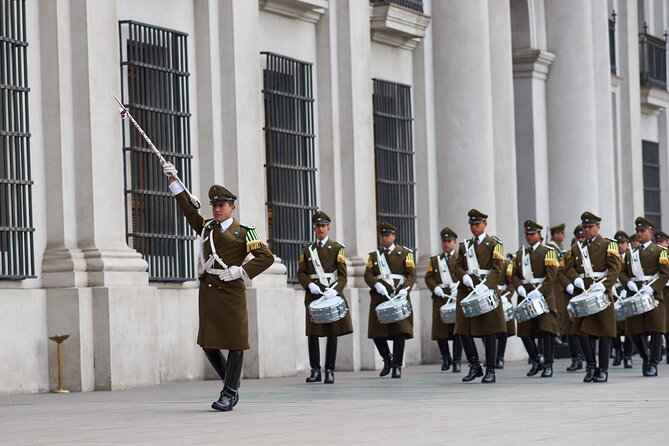
At La Moneda Palace, you watch the Changing of the Guard for about 45 minutes. This is the longest stop and the clear centerpiece of the morning. La Moneda is Chile’s presidential headquarters, so the ceremony carries more weight than a simple display for visitors. Soldiers in polished uniforms parade before the palace while a live military band plays traditional Chilean marches.
The first-row viewing position is an important part of the $39 price. You are not simply passing the palace and hoping to see something through a crowd. You have a planned place to watch the movements, uniforms, music, and formal precision.
I would arrive ready to pay attention to the full sequence. The ceremony is visual, but it also offers a window into Chilean public life and the symbolic role of the presidential palace. Keep in mind that the tour depends on the scheduled ceremony taking place as planned. The supplied details do not specify which days it operates, so confirm the date when booking.
Constitution Square and Santiago’s political center
After La Moneda, the route continues to Plaza de la Constitución. This large square is another important civic space, surrounded by neoclassical buildings and linked closely with Chile’s political life.
The plaza has hosted major public events and demonstrations. That makes it a good place to hear about Chile’s political development, not just admire architecture. The guide may help you connect the palace, the square, and the surrounding government buildings into one functioning center.
You spend about five minutes here. Again, that is enough for a clear explanation and a look around, but not enough for a detailed study of every façade.
The Santiago Stock Exchange is one of the route’s most interesting architectural pauses. Founded in 1893, it occupies a French-style building tied to Chile’s economic growth in the late 19th and early 20th centuries. The exchange remains an important financial center in Latin America.
I like this stop because it widens the tour beyond churches and independence heroes. Santiago’s story also includes trade, banking, foreign influence, and a growing connection to global markets. The elegant building gives that economic story a physical address.
Paseo Nueva York and the old commercial district
Paseo Nueva York is a short street with early 20th-century neoclassical buildings. Its name and design reflect Santiago’s earlier wish to look modern, international, and connected to major cities abroad.
You spend about five minutes here. The street is a quick but worthwhile contrast to the broad government plazas. It feels more intimate, and the architecture shows how Santiago looked toward Europe and the United States while developing its own identity.
The tour then moves toward San Francisco Church, Barrio París-Londres, and Paseo Estado. These short stops work best as a sequence.
San Francisco Church dates to 1618 and is the oldest standing building in Santiago. It survived major earthquakes and contains a collection of religious art. If access is available, the tour includes entry into select churches and historic landmarks, so you may get more than an exterior view. The information provided does not guarantee interior access at every stop, so remain flexible.
Barrio París-Londres is a small neighborhood with an unusual European feel. Its streets break from Santiago’s typical grid and contain buildings with a distinctly old-world character. The area has been designated a Zona Típica, or Typical Zone, since 1982.
At just five minutes, this is not a neighborhood stroll. Still, I think it earns its place because it shows how varied central Santiago can be. A few blocks can shift you from government architecture to a quiet residential-looking quarter.
Paseo Estado is one of the city’s main pedestrian streets. Shops, historic buildings, and constant foot traffic make it a useful link between older landmarks and modern city life. You may not stop for long, but the route gives you a look at Santiago as a working city rather than a set of preserved monuments.
More Walking Tours in Santiago
- The best walking tour in Santiago de Chile
★ 5.0 · 629 reviews - Santiago Half-Day Walking Tour with Hotel Pick up & Food Sample
★ 4.5 · 467 reviews - A Fabulous Walking tour by the Old Santiago of Chile –
★ 5.0 · 466 reviews - Private Santiago 3-Hour Walking Tour
★ 5.0 · 237 reviews
Churches, Casa Colorada, and the road to Plaza de Armas
The Church of St. Augustine, also known as the Augustinians, dates to the early 1600s. It is known for baroque design and the statue of Cristo de Mayo.
The crucifix is tied to a famous earthquake story. According to the tradition connected with it, the statue’s crown shifted during an earthquake but did not fall in the expected way. The tour uses this kind of detail to connect religious art with local memory and natural disasters, both of which have shaped Santiago.
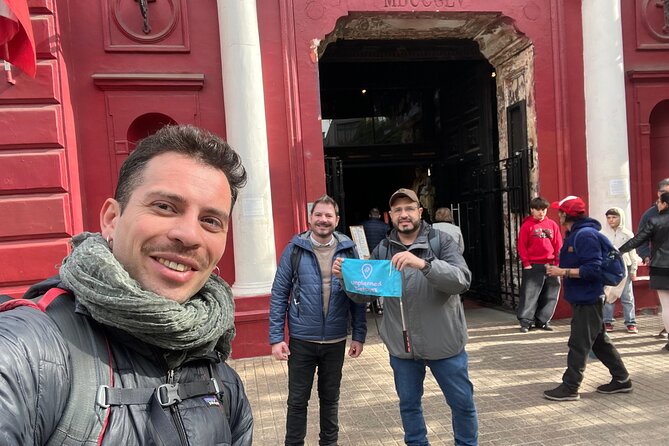
Casa Colorada gives you another view of the colonial city. Built in 1769, it is one of Santiago’s best-preserved colonial mansions. Its red façade is easy to recognize, and the house is linked with important figures from Chile’s independence movement.
These stops are brief, but together they show the layers of central Santiago. You see Spanish colonial foundations, religious institutions, independence-era politics, and later civic expansion. I would not book this tour expecting to linger inside each church or mansion. I would book it to understand how the pieces fit together.
Plaza de Armas and the Metropolitan Cathedral
Plaza de Armas is the historic heart of Santiago. The city was founded in 1541, and this square has served as its main public gathering place for centuries.
The square is surrounded by major buildings and remains a social space, not just a historic marker. Street artists, performers, and local activity bring it to life. You have about 10 minutes here, longer than at most of the earlier stops, so there is time to look around and absorb the scale of the square.
This is one place where a guide adds real value. Without context, Plaza de Armas can feel like a crowded central plaza surrounded by unrelated buildings. With a clear explanation, you can see it as the organizing point of the colonial city and a continuing center of public life.
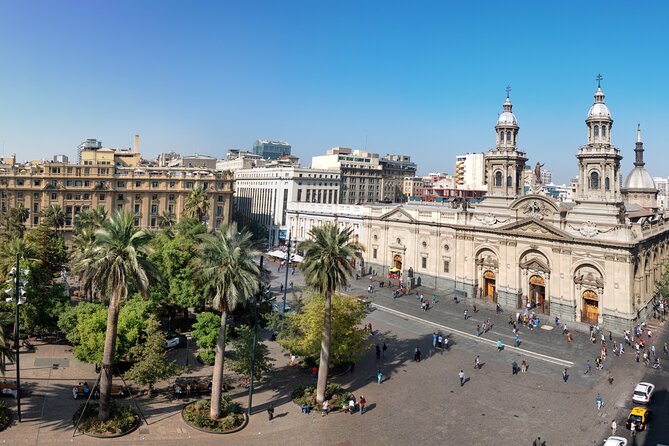
The Metropolitan Cathedral of Santiago sits beside the square. Built between the 18th and 19th centuries, it is a major neoclassical work and the seat of the Catholic Church in Chile. Its interior is richly decorated and reflects the city’s long religious history and repeated rebuilding after earthquakes.
The stop lasts about five minutes. If the cathedral is accessible at the time of the visit, you may enter as part of the guided route. Dress and behave respectfully, since it remains an active religious site. The short visit is enough to see the main interior details, but anyone wanting a full church-art study will need extra time later.
The route also passes the former National Congress building, a 19th-century neoclassical structure surrounded by gardens. It represents Chile’s republican political past and adds another government chapter after La Moneda.
The Museo Nacional de Bellas Artes is housed in a Beaux-Arts building from 1910. It contains one of Latin America’s oldest art collections, with Chilean and international works spanning several centuries. The tour treats it as part of the city’s cultural fabric rather than a full museum visit. If art is a main interest, note the location and return independently with more time.
Finishing above the city at Santa Lucía Hill
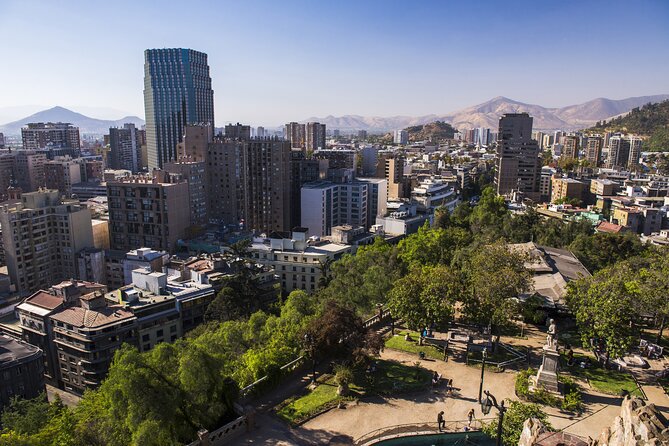
The final major stop is Cerro Santa Lucía, or Santa Lucía Hill. The site began as a rocky outcrop and is now an urban park with stairways, fountains, and viewpoints. Santiago was officially founded here in 1541, making the hill a fitting place to finish a tour about the city’s beginnings and growth.
You spend about 20 minutes at the hill. That is enough to enjoy the setting and panoramic views, though the exact amount of climbing and viewing time will depend on the walking pace and route used by the guide.
This ending works well for practical reasons, too. The tour finishes in front of Neptune’s Terrace, where you have access to several transportation options. You can continue exploring central Santiago, stop for lunch, or use public transit from the area.
The hill does require some stairs and uneven walking. If you have mobility concerns, ask the operator before booking. The supplied information says most people can participate and service animals are allowed, but it does not provide a detailed route for reduced mobility.
Is $39 a fair price?
At $39 per person, I consider this a fair price for a small-group introduction to central Santiago. The admission cost is not the main value, since most sights are free. You are paying for the guide’s time, the organized route, the historical explanations, the first-row ceremony position, and the convenience of covering a large part of the center in one morning.
The group maximum of 10 is especially helpful. A large walking group can make it hard to hear in a plaza or keep track of the guide on a busy pedestrian street. A smaller party also makes it easier to ask about Chilean history, architecture, culture, and current life.
The value drops if you already know central Santiago well or want long visits inside museums and churches. In that case, you may prefer to explore independently and spend more time at fewer places.
For a first visit, though, the price compares well with the amount covered. You see the presidential palace, major civic squares, old religious buildings, colonial architecture, commercial streets, the cathedral, and a hilltop viewpoint without paying separate entry fees.
Who should book this walking tour?
I would recommend it to you if you want a structured introduction to Santiago and prefer local explanation to a self-guided walk. It suits people interested in politics, architecture, religion, urban history, and Chile’s independence story.
It is also useful early in a Santiago stay. The route helps you identify places to revisit, including the Museo Nacional de Bellas Artes, Centro Cultural La Moneda, Plaza de Armas, and Santa Lucía Hill.
Families and older adults should consider the walking time and hill stairs. Most people can participate, but the tour is not a seated sightseeing experience. Comfortable walking shoes are a sensible choice, and you should leave room in your morning for short pauses rather than trying to hurry from landmark to landmark.
I would skip it if your priority is a single museum, an in-depth church tour, or a relaxed café-and-neighborhood walk. The schedule is full, and several stops last only five minutes.
Practical details before you go
The meeting point is the Monument to General Bernardo O’Higgins Riquelme at Avenida Libertador Bernardo O’Higgins, 8330109, Santiago. The start time is 9:30 a.m., and the tour ends at Santa Lucía Hill in front of Neptune’s Terrace.
You receive a mobile ticket, and confirmation is provided at booking. The tour is near public transportation, and the final location offers several ways to continue your day.
Free cancellation is available if you cancel at least 24 hours before the local start time. Changes or cancellations made inside that window are not accepted for a refund.
FAQ
How long is the La Moneda and historic Santiago tour?
The tour lasts approximately 2 hours and 30 minutes.
What time does the tour begin?
The tour begins at 9:30 a.m.
Where does the tour start and finish?
It starts at the Monument to General Bernardo O’Higgins Riquelme on Avenida Libertador Bernardo O’Higgins. It finishes at Santa Lucía Hill in front of Neptune’s Terrace.
Is the Changing of the Guard included?
Yes. The tour includes a first-row view of the Changing of the Guard ceremony at La Moneda Palace, with soldiers and a live military band.
How many people can join the tour?
The maximum group size is 10 people. Arrangements can be made for parties of 10 or more.
Is cancellation free?
Yes, you can cancel for a full refund up to 24 hours before the experience start time. Cancellations or changes made less than 24 hours before the start are not refunded or accepted.
Should you book it?
I would book this tour if you want to understand Santiago’s center quickly and with context. The first-row La Moneda ceremony, the small group, and the final views from Santa Lucía Hill give the morning a clear shape. Emmanuel’s ability to connect history with Chile’s future and Ignacia’s evident enthusiasm also suggest the guiding can be a strong part of the experience.
Just keep your expectations in line. This is a brisk overview, not a series of long museum visits. If that sounds right for your first morning in Santiago, $39 buys a useful route, a memorable civic ceremony, and a solid foundation for exploring the city on your own.
More Historical Tours in Santiago
- Essence of Santiago : History, Flavors and Panoramic Views
★ 5.0 · 45 reviews - Santiago Walking Tour: Heart of Santiago, Queer History & Culture
★ 5.0 · 27 reviews - Santiago: Private tour, historic center, high altitude viewpoint, cable car
★ 4.9 · 27 reviews - La Moneda Palace, Plaza de Armas & Historic Santiago Walking Tour
★ 5.0 · 20 reviews
Just added around Santiago
- Walking City Tour with Funicular, Cable Car and Tasting★ 4.3 · 6 reviews
- Tour VIÑA CONCHA Y TORO + CASA MARQUES – Chile, from Santiago.★ 5.0 · 2 reviews
- VIÑA DEL MAR AND VALPARAISO TOUR★ 4.8 · 20 reviews
- Undurraga Wine tour★ 4.2 · 15 reviews
- Undurraga + Isla Negra + San Afonso del Mar —– Full day★ 4.1 · 8 reviews
- wetravelneruda’s route – Pablo Neruda’s route – Private tour★ 5.0 · 6 reviews
- Southcoast – Private Full-Day tour★ 5.0 · 6 reviews
- Santiago Private walking tour with Lunch★ 5.0 · 5 reviews
Historical Tours, compared.
Tour Viña Santa Rita: History, Wine and Picnic Outdoors
Read our review →
Elqui Valley Tour: History and Flavors (NOT FOR CRUISES)
Read our review →
Viña Del Mar and Valparaiso world heritage site.
Read our review →
Walking Tour Valparaiso, History & Art – Private Optional
Read our review →
Essence of Santiago : History, Flavors and Panoramic Views
Read our review →
2 Day Private Tour: Easter Island’s Cultural Heritage
Read our review →
Browse the lists this tour appears in