

Reviewed · CITY TOURS
Santiago Half Day City Tour Private with Vehicle
Santiago reveals itself one civic square at a time. I like the private vehicle, which saves time between downtown sights, and I like the thoughtful attention to Chilean politics and current affairs, especially with guide Juan Pablo when he is available. The main drawback is Cerro Santa Lucia, where uneven paths and uphill walking require moderate fitness.
This is a compact introduction to Santiago, lasting about three and a half to four hours. You will see the city’s government center, main square, cathedral, courthouse, former Congress, and a leafy hilltop park, with time to ask questions instead of simply photographing monuments and moving on.
In This Review
- Key points to know before booking
- Starting in Las Condes and heading downtown
- Cerro Santa Lucia: a green pause above downtown
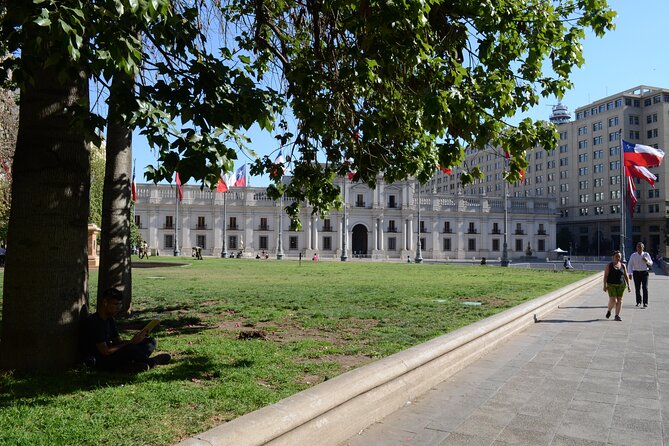
- La Moneda and Constitution Square: Chile’s civic center
- Plaza Montt Varas and Chile’s three branches of government
- Plaza de Armas: where Santiago began
- Metropolitan Cathedral: a quiet look inside
- How the guide shapes the day
- Is $150 per person good value?
- Who will enjoy this Santiago tour most?
- My call: book it for context, not just checkmarks
- FAQ
- How long does the Santiago private city tour last?
- Where does the tour begin?
- Where does the tour end?
- Is this a private activity?
- Is lunch included?
- Does the tour include admission fees?
- What fitness level is needed?
Key points to know before booking
- Private touring with a vehicle: Only your group takes part, with transportation between the central sights.
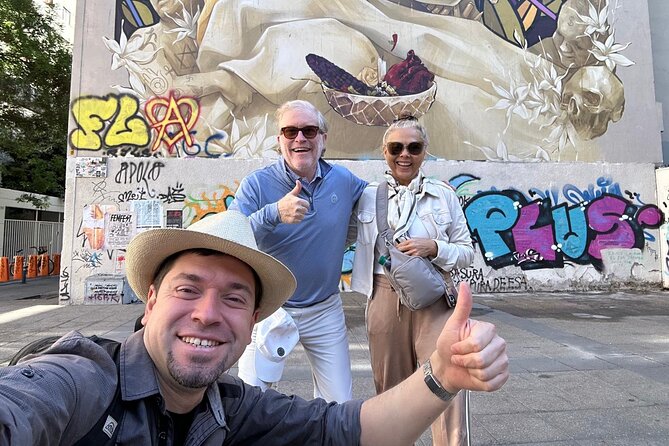
- Juan Pablo may guide you: He is praised for humor, careful answers, and strong knowledge of Chilean history and current events, though another guide may lead the tour depending on availability.
- Cerro Santa Lucia requires walking: Trails are uneven, and reaching the upper tower takes more effort than stopping at the main terrace.
- Chile’s political past is central: La Moneda, Constitution Square, the Supreme Court, and the former Congress give the tour serious civic context.
- The cathedral visit is respectful and quiet: Photography is permitted in many areas, but flash, food, drinks, and loud conversation are not appropriate.
- The price reflects privacy: At $150 per person, this is not a budget sightseeing circuit, but a private group, guide, vehicle, and flexible discussion can make it worthwhile for families or first-time visitors.
Starting in Las Condes and heading downtown
The meeting point is Bici Las Condes at Reyes Lavalle 3310 in Las Condes. The tour ends back at the same point, so you should allow time for the return journey when planning lunch, an airport transfer, or another appointment.
The private format matters in Santiago. You are not waiting for a large group to board a bus or trying to hear a guide over strangers. You can ask about the political events connected to a building, slow down at a viewpoint, or adjust the pace for children. The vehicle also gives you a break between walking stops.
The tour is advertised for approximately three hours and thirty minutes to four hours. The listed visits add up to about three and a half hours, although traffic, questions, and the pace of your group can affect the final timing.
Transportation is described as a clean and comfortable car, with a careful driver. That detail matters more than it may first seem. This tour covers several central locations, and the vehicle lets you connect them without turning the day into one long walk.
More City Tours in Santiago
- Private Santiago City Half Day Tour
★ 4.0 · 414 reviews - Santiago: Full day tour to Valparaiso and Viña del Mar city
★ 4.0 · 188 reviews - City tour by Santiago of Chile -A beautiful experience – Half day
★ 4.5 · 176 reviews
Cerro Santa Lucia: a green pause above downtown
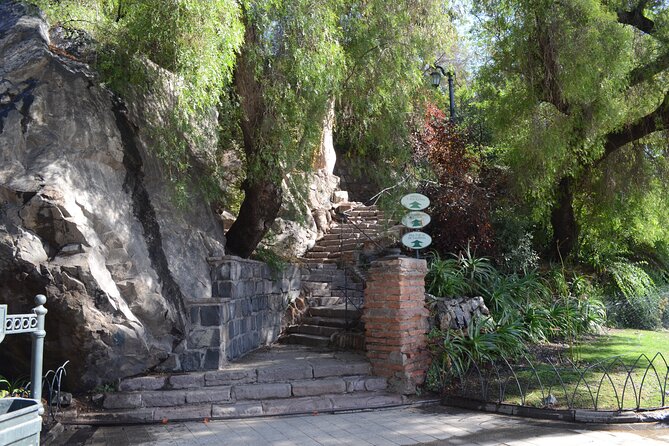
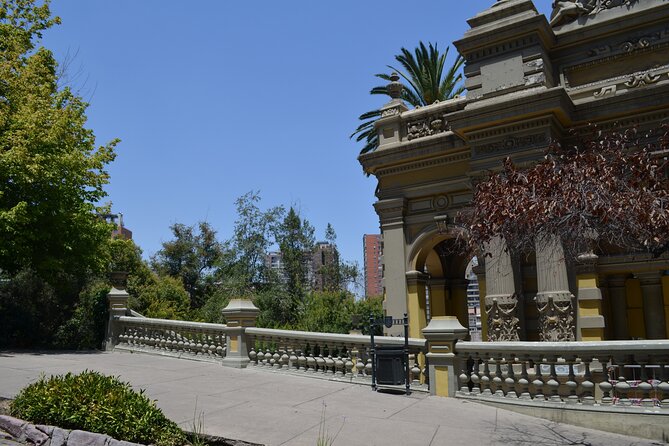
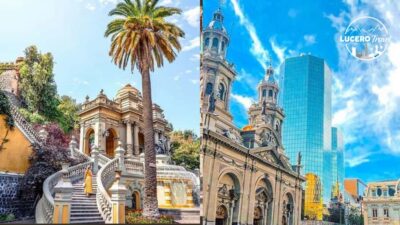
Cerro Santa Lucia is the tour’s most physical stop and its most relaxed one. This small hill rises amid central Santiago, creating a pocket of greenery where downtown noise fades. Paths, terraces, and lookout points give you a change of pace before the tour returns to government buildings and formal squares.
You can stop at the main terrace or continue higher toward the tower. I would treat the upper climb as optional rather than a test you must pass. The hill is a rocky urban park, and the trails are uneven, so sturdy shoes and a sensible pace will help.
The reward changes as you move. There is no single sweeping view of all Santiago from this point, but that is part of its appeal. Instead, you find smaller angles through trees, walls, and terraces, with close views of portions of the city.
Your guide can use the stop to explain how the hill fits into Santiago today, as well as its place in local recreation and urban life. You get time for photographs and conversation rather than a rushed lookout visit.
Families should know that this is not a fully flat garden stroll. Children may enjoy the stone paths and tower, while anyone with limited mobility may prefer the lower terrace. The tour notes a moderate fitness requirement, and this is the clearest reason why.
La Moneda and Constitution Square: Chile’s civic center
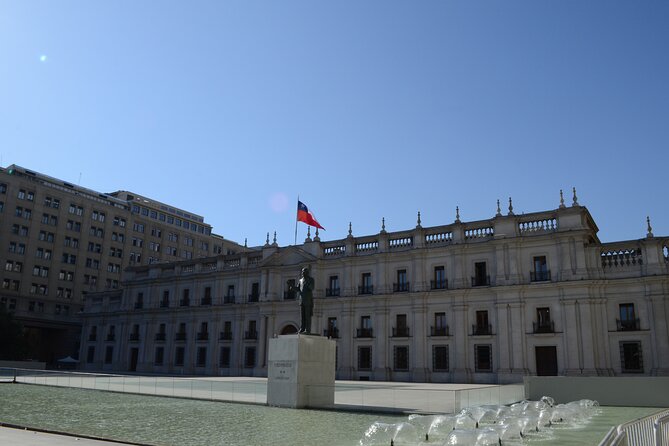
The next part of the tour focuses on Palacio de La Moneda, Chile’s government palace. The building began life as a mint, not a presidential residence, and opened in 1804 after work led by the Roman architect Joaquín Toesca. He arrived in colonial Santiago in 1780 but did not live to see the project finished.
That origin gives the building an unusual character. It was built with a mix of techniques and served as a major colonial craft project before Chile’s independence process was complete. Today, its meaning is tied to the executive government and to some of the hardest chapters in the country’s modern past.
The 1973 coup d’état took place here. A good guide will not reduce that event to a quick date and move on. The setting allows a wider conversation about civic duty, human rights, government, and Chile’s hopes for the future.
You will then spend time at Plaza de la Constitución, the green square on the north side of the government district. Government ministries surround it, while families and dogs use the open space in a more ordinary daily way.
The changing of the guard takes place every 48 hours and includes instrumental music. The tour description does not promise that your visit will coincide with it, so do not book this outing solely for that ceremony. If the timing works, it can add a formal, memorable moment to the stop.
Statues of former presidents line the area and help put Chile’s political development into a physical setting. The guide may also discuss the economy, public opinion, and current issues. I like this approach because it gives you information without pretending that a short city tour can settle every political question.
Plaza Montt Varas and Chile’s three branches of government
Plaza Montt Varas is smaller and more pointed in its message. Flat fountains and statues of President Manuel Montt and Antonio Varas face the imposing Supreme Court of Justice.
The court’s gates may attract demonstrations, a reminder that justice can look different to different people. That is a useful observation for a city tour because it connects the building to public life rather than treating it as a decorative facade.
Across from the court is the former National Congress. The building was closed after the 1973 coup d’état, although important meetings now take place there. Entry is not always permitted, even though the area itself is public, so expect an exterior explanation rather than a guaranteed indoor visit.
This thirty-minute stop is short but worthwhile if you enjoy institutions, public affairs, and the structure of government. Your guide can explain the three branches of the republic and how the buildings around the square fit together.
For some families, this may be the least exciting stop. There is no major interior visit promised, and the subject matter is more serious than scenic. If you prefer architecture and public spaces over political discussion, you may find the explanation more interesting than the square itself.
More Private Tours in Santiago
- Private Transfer from Santiago Airport to Santiago
★ 4.0 · 330 reviews - Private Transfer between Santiago and the Airport
★ 5.0 · 292 reviews - Private Tour: Half-Day Santiago Discovery
★ 5.0 · 276 reviews - Private Santiago 3-Hour Walking Tour
★ 5.0 · 237 reviews
Plaza de Armas: where Santiago began
Plaza de Armas is the city’s historic center and one of the places where Santiago’s civic life is easiest to picture. The square was established on February 12, 1541, when Pedro de Valdivia placed the governor’s house along its northwest side, at least according to the commonly accepted account.
From this open space, colonial Santiago organized itself. Horses, weapons, carts, and fortifications once occupied the area or stood nearby. Churches, government offices, the jail, city council, gallows, livestock events, religious ceremonies, and public contests later filled out the square’s role.
The important point is not to memorize every former use. It is to understand why the plaza has remained the city’s central stage for so long. It began as a practical Spanish colonial grid and became a civic center for the young republic in the nineteenth century.
Today, Plaza de Armas carries a more everyday character. Commerce, entertainment, and local traditions share the space, and there is usually something to observe. The tour allows about thirty minutes here, enough to take in the square and hear how its role has changed.
The guide’s invitation to picture the square across different periods is valuable. You are not simply looking at paving stones and surrounding buildings. You are seeing a place that has served military, religious, political, and social purposes over centuries.
Still, this is a busy public area, and the tour’s short stop means you will not explore every surrounding street. If you want a slower look at central Santiago, you may need to return on your own.
Metropolitan Cathedral: a quiet look inside
The Metropolitan Cathedral occupies the western side of Plaza de Armas and gives the tour a calmer interior stop. Its construction stretched from the middle of the eighteenth century into the nineteenth century, after earlier churches on the site had been replaced.
The present building changed repeatedly after its consecration and continued to receive modifications until before the First World War. That long building process helps explain why the cathedral is best read in layers rather than as a single perfectly unified design.
Inside, you can look for symbols connected with kindness, martyrdom, patriotism, and religious devotion. The Capilla del Santísimo Sacramento and the Parroquia El Sagrario are particularly important parts of the complex.
Photography is allowed in many areas unless a sign says otherwise. Turn off your flash, keep your voice low, and do not bring food or drinks inside. Services take place during the week and on weekends, with noon described as the most likely time to encounter one, so the visit may need to be quiet and brief.
This stop lasts about thirty minutes. It works well after the open public space outside because the mood changes immediately. You move from the noise and movement of the plaza into a place designed for prayer and reflection.
The cathedral is not presented as an elaborate museum visit, and you should not expect a long guided examination of every chapel. Its value comes from seeing a functioning religious site that remains part of Santiago’s daily life.
How the guide shapes the day
The strongest part of this tour is the guide’s role. Juan Pablo is the named guide when available, although the operator may assign someone else. His style, based on the information provided, combines humor with serious discussion and gives you room to ask about current events in Chile.
That mix is useful. A guide who only recites dates can make La Moneda and the former Congress feel remote. A guide who only entertains may skip the difficult subjects that give these places meaning. Here, the aim is to provide background and let you form your own view.
The tour has also been praised for careful driving, a clean vehicle, kind attention, and useful local tips. Those qualities are especially helpful if you are traveling with children. One family found the pace long enough to see central, middle, and upper parts of Santiago without making the day too heavy for younger children.
You should still tell the guide what interests your group. The private setting makes it easier to ask for more context on architecture, politics, religion, or everyday city life. It also lets you say when the group needs a pause.
Is $150 per person good value?
At $150 per person, this is a premium half-day outing. The price includes the private guide, vehicle, admission fees, and transport back to the meeting point, but not lunch.
The value depends heavily on group size. For one or two people, the cost is substantial. For a family or small group, a private vehicle and guide may compare more favorably with arranging separate transport, paying for a guide, and trying to coordinate several central stops alone.
I would choose this tour when time is limited and you want a structured first look at Santiago. The itinerary brings together a park, palace, government square, court, former Congress, main plaza, and cathedral. That range gives you a useful framework for later independent exploring.
I would hesitate if you want an inexpensive walking tour or a long museum visit. This is not a food tour, and lunch is not included. It also does not promise entry to every building, especially the former Congress, where access can vary.
The private format is the main reason to pay more. You are buying conversation, convenience, and a car between stops, not a long list of admission tickets.
Who will enjoy this Santiago tour most?
I think this tour suits first-time visitors, families, couples, and small groups who want orientation without spending a full day on the road. It is also a good fit if Chilean politics and recent history interest you.
Families may appreciate the balance between outdoor space, short visits, and vehicle time. The guide can add humor and answer questions, while Cerro Santa Lucia gives children room to move, provided they can manage uneven ground.
It may be less suitable for anyone who needs fully level routes or wants a slow, highly specialized architecture tour. Cerro Santa Lucia includes rocky and uneven trails, and the schedule gives only about thirty minutes to several downtown sites.
Safety planning deserves a plain mention. The operator states that no insurance is included for theft or assault, and no insurance is included for traffic accidents or other road incidents. Keep your belongings close and confirm any personal insurance needs before booking.
Free cancellation is available if you cancel at least 24 hours before the local start time. Cancellations or changes made later are not accepted for a refund.
My call: book it for context, not just checkmarks
I would book this private Santiago tour if I wanted a well-organized introduction with real discussion around the sights. The best moments are not only the photos from Cerro Santa Lucia or the cathedral. They are the connections between La Moneda, the 1973 coup, Chile’s government institutions, and the public life unfolding in the squares today.
Choose it especially if you value a careful driver, a comfortable vehicle, and the chance to ask direct questions. If you are watching every dollar, have more time, or prefer to wander independently, the $150 price may be hard to justify.
For most first visits, though, the combination of central landmarks, private transport, and a guide such as Juan Pablo makes this a practical half-day foundation for Santiago.
FAQ
How long does the Santiago private city tour last?
The tour lasts approximately three hours and thirty minutes to four hours.
Where does the tour begin?
It begins at Bici Las Condes, Reyes Lavalle 3310, 7550121 Las Condes, in the Santiago Metropolitan Region.
Where does the tour end?
The activity ends back at the meeting point in Las Condes.
Is this a private activity?
Yes. Only your group participates in the tour.
Is lunch included?
No. Lunch is not included in the price.
Does the tour include admission fees?
Yes. All fees and taxes are included. The listed stops at Cerro Santa Lucia and Constitution Square include admission, while Plaza Montt Varas, Plaza de Armas, and the Metropolitan Cathedral are listed without an admission charge.
What fitness level is needed?
A moderate level of fitness is recommended. Cerro Santa Lucia has uneven trails and optional uphill walking toward the tower.
Just added around Santiago
- Walking City Tour with Funicular, Cable Car and Tasting★ 4.3 · 6 reviews
- Tour VIÑA CONCHA Y TORO + CASA MARQUES – Chile, from Santiago.★ 5.0 · 2 reviews
- VIÑA DEL MAR AND VALPARAISO TOUR★ 4.8 · 20 reviews
- Undurraga Wine tour★ 4.2 · 15 reviews
- Undurraga + Isla Negra + San Afonso del Mar —– Full day★ 4.1 · 8 reviews
- wetravelneruda’s route – Pablo Neruda’s route – Private tour★ 5.0 · 6 reviews
- Southcoast – Private Full-Day tour★ 5.0 · 6 reviews
- Santiago Private walking tour with Lunch★ 5.0 · 5 reviews
City Tours, compared.
Full day tour to Valparaiso and Viña del Mar city
Read our review →
City tour by Santiago of Chile -A beautiful experience – Half day
Read our review →
Half-Day Sightseeing City Tour with Chauffeur and Guide
Read our review →
Valparaiso 4-Hour City Tour by Van and Funicular
Read our review →Browse the lists this tour appears in