
Reviewed · ATACAMA DESERT TOURS
From San Pedro de Atacama: The Salt Flats Route, Full day
High desert, huge views, real altitude. This six-hour trip from San Pedro de Atacama heads toward the Paso de Jama border route, climbing through lava, ash, salt flats, volcanoes, and high-altitude wetlands. I like the chance to see Licancábur volcano at 5,916 meters and the rare birds and plants of the altiplano. I also like that breakfast and a snack are included, which matters when the morning starts early. The main caution is that the advertised visit to Salar de Tara may not always happen, so I would confirm the exact route before booking.
The outing costs $78 per person and includes hotel pickup in central San Pedro, shared transport, and a Spanish-English guide. It is a strong choice if you want dramatic scenery without committing to a longer multi-day trip. Still, the high altitude, repeated stops, and uneven guiding quality mean this is not a carefree outing for everyone.
In This Review
- Key points at a glance
- Leaving San Pedro for the Paso de Jama route
- The first big view over Salar de Atacama
- Licancábur, the volcano that defines the view
- What the altitude means at 4,500 meters
- Wildlife among the lava and ash
- The Pakana hills and the Moai of Tara
- Salar de Tara and the route question
- Guides, language, and group comfort
- Is $78 a fair price?
- Who should book this outing?
- Final call: book it after confirming the endpoint
- FAQ
- How long does the Salt Flats Route take?
- Where does pickup take place?
- What language is the tour guide?
- Is breakfast included?
- What should I bring?
- How high does the route go?
- Who cannot join this activity?
- Is Salar de Tara guaranteed?
Key points at a glance
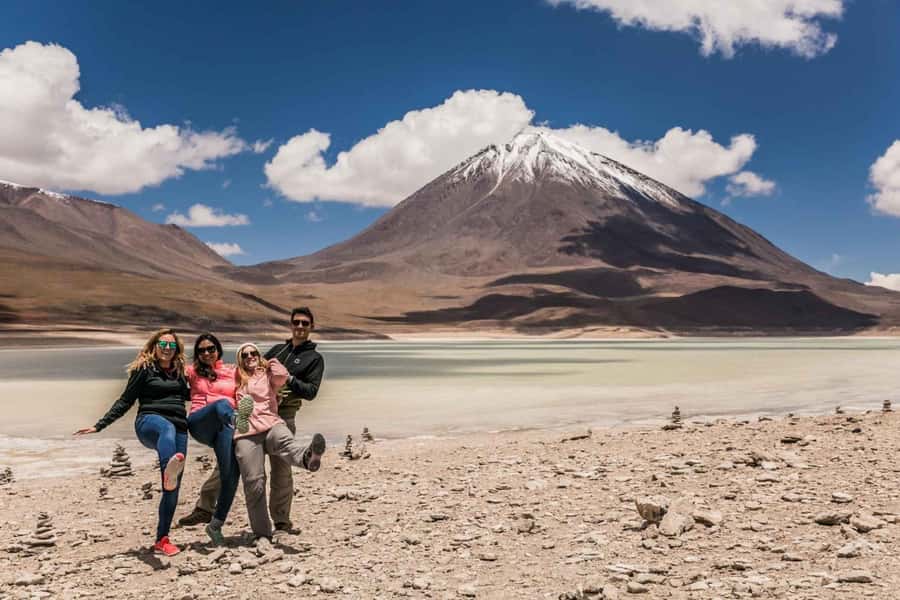
- Licancábur at 5,916 meters: Breakfast comes with a view of one of the Atacama’s most memorable volcanoes, sometimes dusted with snow.
- A high-altitude route: The trip reaches about 4,500 meters, so altitude is a serious part of the experience, not a footnote.
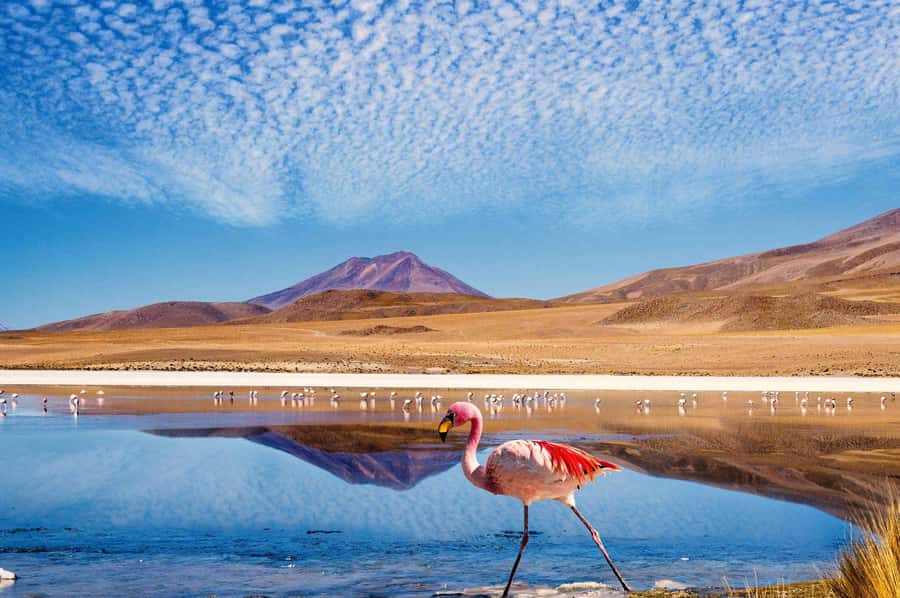
- Flamingos and altiplano wildlife: Small lakes along the route can hold flamingos and other birds, while groups of ostrich-like ñandú may appear farther along.
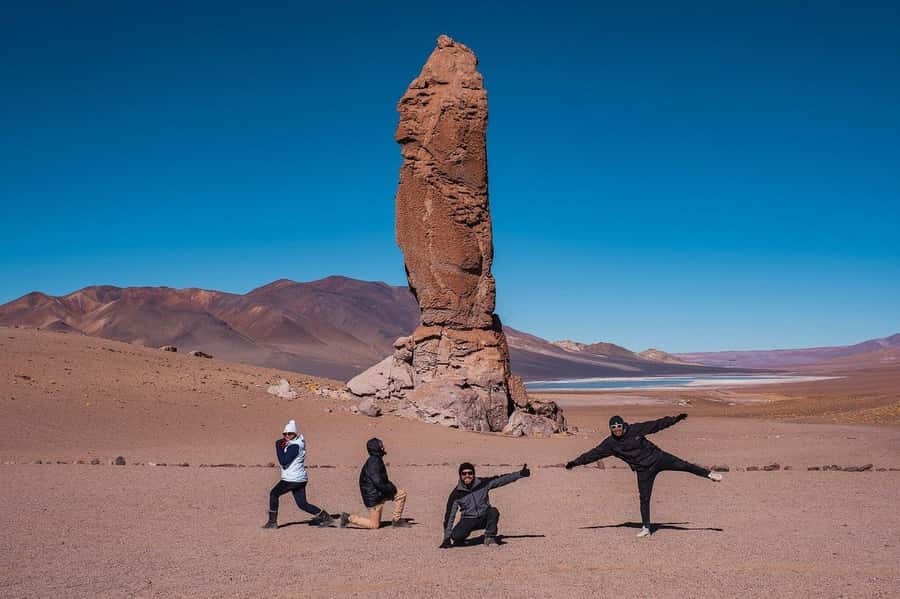
- Tara’s strange rock formations: The route is designed to include the Pakana hills, Tara wall, Moai of Tara, and Cathedrals of Pakana.
- A tour with one important question: Some bookings have reportedly not reached Salar de Tara, despite the advertised itinerary.
- Good value for a half-day: Pickup, bilingual guiding, breakfast, and a snack are covered, but tickets, extra food, and drinks are not.
Leaving San Pedro for the Paso de Jama route
Pickup begins at 8:00 a.m. from hotels, apartments, and other accommodation in downtown San Pedro de Atacama. The transport is shared, so you should expect to travel with a mixed group rather than in a private vehicle.
The route follows the international road toward Paso de Jama and the Chilean border-control area. You need to bring your passport or identification card. That requirement is easy to overlook because this is sold as a sightseeing trip, but the road runs through a border region and your documents are essential.
The drive quickly leaves the lower desert behind. The road climbs steadily over ground formed by lava and ash, and the change in scenery is part of the pleasure. Atacama trips often begin with a familiar image of dry desert and dusty hills. This one gradually trades that view for wide salt basins, dark volcanic ridges, and high open country.
I appreciate that the first part of the route gives you time to watch the terrain change. You are not simply taken to one viewpoint, shown a salt flat, and driven back. The road itself is the introduction to the altiplano.
Other Atacama desert trips from San Pedro De Atacama:
- San Pedro de Atacama: El Tatio Geysers Tour
★ 4.7 · 943 reviews - San Pedro de Atacama: Etno-Stargazing Tour with Transfer
★ 4.8 · 629 reviews - The Roofless Experience San Pedro de Atacama Stargazing Tour
★ 5.0 · 522 reviews
The first big view over Salar de Atacama
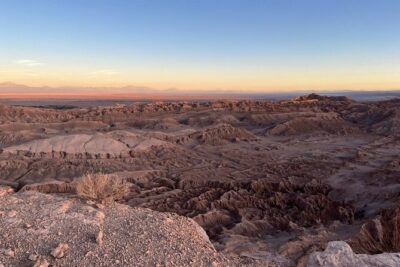
One early stop offers a panoramic view across the Salar de Atacama and the oasis around San Pedro. From above, the contrast is sharp: pale salt country, dry volcanic ground, and the green pocket created by the oasis.
This is a useful orientation point. It helps you understand San Pedro’s setting before the road climbs higher. The oasis is not a large green valley in the usual sense. It is a concentrated patch of life in one of the driest places on earth, surrounded by broad, empty desert.
The stop also gives you a chance to settle into the pace. This is a sightseeing route with several pauses, not a single quick photo stop. One practical warning comes from the repeated getting in and out of the vehicle. A booking from April 2024 described many stops and found the constant changes a little tiring. If you have limited mobility or simply dislike frequent roadside stops, that part of the day may wear on you.
Licancábur, the volcano that defines the view
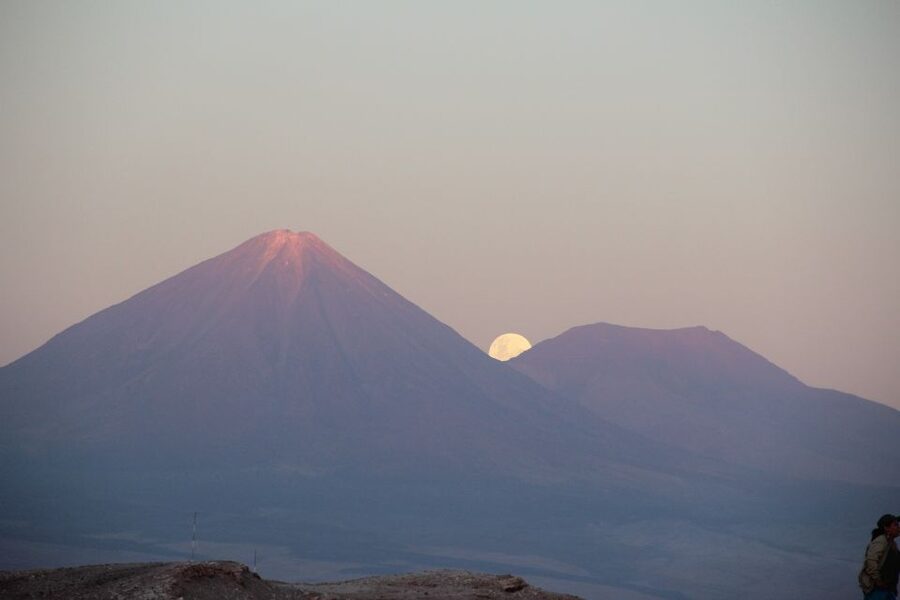
At about kilometer 41, the road reaches roughly 4,200 meters. A turn or crossing toward Hito Cajón provides a view of Licancábur, the near-perfect volcanic landmark rising to 5,916 meters.
Licancábur is more than a pretty mountain backdrop. It gives scale to the region. The surrounding country can look flat and open, but this volcano makes clear that you are moving through a major volcanic zone. Its height also helps explain why the air feels thin and why cold conditions can arrive even in a desert.
The included breakfast is served with a view of Licancábur. One particularly good morning included a lightly snow-covered summit, which made the stop even more memorable. You should not count on snow every time, but the possibility shows how quickly conditions can change at this height.
I would treat breakfast as both a meal and a useful pause. Eat slowly, drink water, and avoid rushing around for photographs. One person on the trip had altitude trouble, and the guide did not initially check how everyone was coping. That is a fair warning: the guide may organize the route, but you still need to monitor yourself.
What the altitude means at 4,500 meters
The route eventually reaches Salar de Tara at about 4,500 meters, according to the planned itinerary. That is high enough for the altitude to shape the day.
The activity is not suitable for children under 10, pregnant women, or people with high blood pressure. Those restrictions should be taken seriously. Even if you are fit, you may notice breathlessness, a headache, tiredness, or a slower pace at this height.
A sensible preparation tip from the experience is to drink plenty of water the day before. One booking specifically recommended four to five liters, though you should use your own medical judgment and avoid forcing excessive water. The useful point is to arrive hydrated, not to treat water as a cure for altitude illness.
The guide once offered a local high-altitude herb to smell when someone was feeling unwell. That may be a traditional gesture, but it should not replace proper caution. If you feel seriously ill, tell the guide at once and do not try to push through just to reach the next photo stop.
Other salt flat and lagoon runs:
- Piedras Rojas, Altiplanics Lagoons & Salar Full-Day Tour
★ 4.7 · 592 reviews - Piedras Rojas + Altiplanic Lagoons and Salar de Atacama
★ 5.0 · 218 reviews - Red Stones and Altiplanica Lagoons Salar de Atacama
★ 5.0 · 97 reviews - Tour to Laguna Cejar, Ojos del Salar and Laguna Tebinquiche
★ 4.5 · 37 reviews
Wildlife among the lava and ash
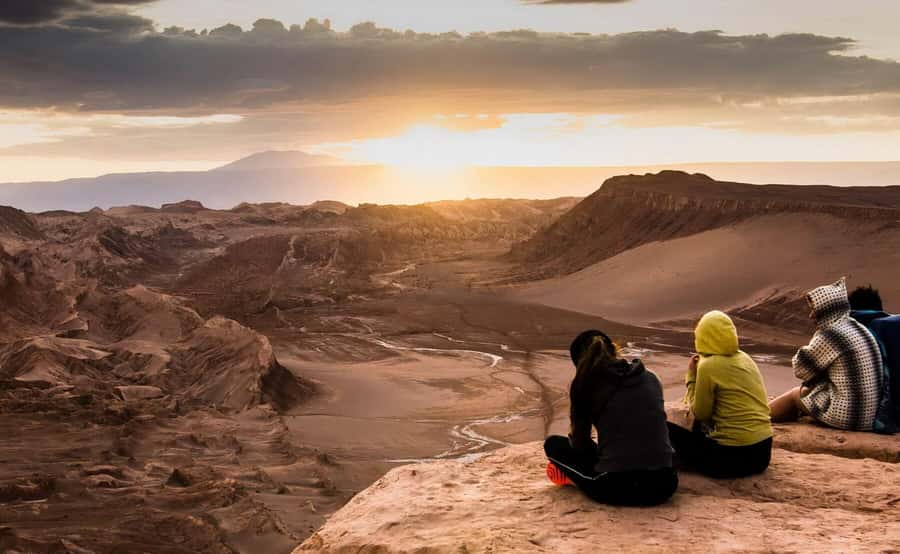
As the road continues between high mountains, you might see groups of ostrich-like birds, identified in the itinerary as ostriches. In the altiplano, wildlife sightings are never guaranteed, so keep your eyes open rather than expecting a staged encounter.
Around kilometer 75, the route passes small lakes where flamingos and other birds live. These wetlands are one of the best reasons to choose this trip. The salt flats are visually dramatic, but the birds show that the area is not lifeless.
Flamingos in this setting are especially striking because they feed and survive in shallow, mineral-heavy water surrounded by severe dry country. The most common bird noted for the Salar de Tara area is the Chilean flamingo. You may also see other birdlife around the small lakes, but the exact sightings depend on conditions and timing.
Bring patience for these stops. The birds may be distant, and the best view may be a quiet one rather than a close photograph. You should also avoid assuming that every stop will offer a large flock. The appeal is the chance to see life in a place that first looks empty.
The Pakana hills and the Moai of Tara
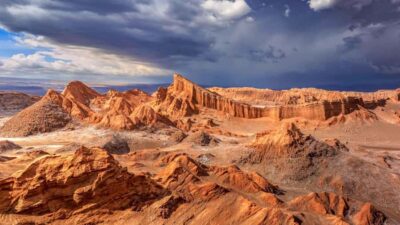
Around kilometer 91, the route passes through the Pakana hills. The scenery becomes more sculptural, with volcanic rock shaped into tall columns, walls, and odd forms.
The Farellón of Tara is a rock wall carved into natural sculptures. It is one of those Atacama sights that rewards a little imagination without needing much explanation. Wind, erosion, and old volcanic activity have left a set of forms that can look like architecture from a distance.
A little farther on, the itinerary points to the Moai of Tara, also called the Pakana Witness. These columns are rock structures preserved through geological time. They are linked to violent volcanic events during the Tertiary period, giving the stop a useful geological story rather than just a strange name.
The name Moai is a visual comparison, not evidence that the formations are related to Easter Island. You are looking at local volcanic formations, and the value lies in their shape and setting. They rise from a broad, stark expanse where the lack of trees and buildings makes every rock form easier to read.
The Cathedrals of Pakana provide another wide view of the formations. I like this section because it feels less polished than a standard viewpoint. You see a large natural setting with several points of interest, and the effect comes from scale, silence, and unusual stone shapes.
Salar de Tara and the route question
The planned endpoint is Salar de Tara, at about 4,500 meters. It is described as a salt lake with a distinct ecosystem, birdlife, and broad views of the surrounding formations.
There is an important wrinkle here. One French booking from July 2025 specifically said the group did not reach Salar de Tara, even though the excursion description promised it. That means you should ask the operator, Ruta Chile, what the current route includes on your chosen date.
This is not a small wording issue. Salar de Tara is the main title attraction, and a trip that stops at nearby formations without reaching the salt lake may feel different from what you expected. Conditions, route changes, permits, or local decisions might affect the day, but the exact reason is not provided here. Get a clear answer before you pay if Salar de Tara is your main goal.
The advertised route still contains worthwhile sights even if the final salt flat is missed. Licancábur, the wetlands, Pakana formations, and the high-altitude scenery form a strong half-day outing. But you should book it with realistic expectations rather than assuming every listed point is guaranteed.
Guides, language, and group comfort
The tour includes a live guide in Spanish and English. That can work very well when the guide gives full explanations in both languages. Pedro received especially strong praise for making the day enjoyable and well run.
The guiding is not always equally strong. One English-speaking guide was criticized for translating only fragments of the Spanish explanations. If you speak only English, that matters. You could miss the geological background and practical instructions even while enjoying the views.
Group position inside the vehicle can also affect the day. A French booking reported being picked up near the end and sitting toward the back, where questions and answers were hard to hear. When you board, try to find a seat where you can hear the guide clearly, though seating control may be limited in a shared vehicle.
This is one reason I would rate the guide as an important part of the value. The scenery needs no translation, but the story of the volcanoes, rock formations, birds, and salt ecosystem adds much more to the trip. If the English explanation is thin, the excursion becomes mainly a scenic transfer with stops.
Is $78 a fair price?
At $78 per person, I see reasonable value if the route runs as planned. You receive hotel pickup in central San Pedro, shared transport, a bilingual guide, breakfast, and a snack. A six-hour outing also gives you a substantial morning and early afternoon without taking over your entire day.
The price does not include tickets, meals beyond the stated breakfast and snack, or drinks. Since the exact ticket cost is not supplied, budget a little extra rather than assuming the $78 covers every payment.
The value depends heavily on three things: reaching the advertised locations, receiving useful bilingual explanations, and handling the altitude well. If all three work, the price is attractive for access to remote high-country scenery. If Salar de Tara is skipped and the guiding is weak, the value falls.
I would not choose this trip only because it is cheaper than a private outing. Shared transport usually means less control over seating, timing, and the number of stops. I would choose it because the included food and pickup make the logistics simple and because the route covers several major sights in one morning.
Who should book this outing?
I would recommend it to you if you want striking volcanic scenery, salt flats, birds, and unusual rock formations in a compact trip from San Pedro. It suits people who are comfortable with shared transport, a high number of stops, and serious altitude.
It is also a good fit if you want a guide to connect the scenery to the geology. The Pakana formations are more interesting when you understand how they formed, and the flamingo wetlands are more meaningful when you notice how life survives in such a dry place.
I would hesitate if you are sensitive to altitude, need a slow and carefully monitored pace, or require a guaranteed visit to one exact site. I would also be cautious if you speak only English and cannot confirm that the guide will translate fully.
The outing is not suitable for children under 10, pregnant women, or people with high blood pressure. Bring your passport or ID card, drink water before the trip, and tell the guide quickly if you feel unwell.
Final call: book it after confirming the endpoint
I would book the Salt Flats Route if you want a broad sample of the high Atacama and can accept some uncertainty in the exact route. The combination of Licancábur, flamingos, Pakana rock formations, and a high-altitude salt ecosystem offers plenty of visual reward for $78.
Before booking, ask one direct question: Will the group reach Salar de Tara on this date? Then ask how English explanations are handled and how pickup timing is organized. If the answers are clear, this is a worthwhile and efficient outing. If Salar de Tara is non-negotiable, choose only after the operator confirms it.
FAQ
How long does the Salt Flats Route take?
The activity lasts six hours. Pickup begins at 8:00 a.m.
Where does pickup take place?
Pickup is included from hotels, apartments, and other accommodation in downtown San Pedro de Atacama.
What language is the tour guide?
The live guide speaks Spanish and English.
Is breakfast included?
Yes. Breakfast and a snack are included.
What should I bring?
Bring your passport or ID card. You should also prepare for high altitude by arriving well hydrated.
How high does the route go?
The route reaches about 4,500 meters at Salar de Tara. A point near kilometer 41 is around 4,200 meters, and Licancábur rises to 5,916 meters.
Who cannot join this activity?
The activity is not suitable for children under 10, pregnant women, or people with high blood pressure.
Is Salar de Tara guaranteed?
The planned itinerary includes Salar de Tara, but one booking reported that the group did not reach it. Confirm the current endpoint with Ruta Chile before booking if this stop is essential to you.
Just added around San Pedro De Atacama
- Vallecito★ 4.7 · 13 reviews
- Atacama Desert and Magic Bus Visit★ 4.8 · 15 reviews
- San Pedro de Atacama: Valle de la luna★ 3.0 · 3 reviews
- Valle de la Luna: A Moon-Like Escape in Atacama★ 5.0 · 3 reviews
- 3 Perfect Days in Atacama + Transfer★ 4.5 · 3 reviews
- Atacama Stargazing Tour Under One of the World’s Clearest Skies★ 4.0 · 3 reviews
- Valley of the Moon In San Pedro de Atacama★ 4.5 · 9 reviews
- Moon Valley Tour, the Best Seller★ 4.5 · 2 reviews
Atacama Desert Tours, compared.
The Roofless Experience San Pedro de Atacama Stargazing Tour
Read our review →
Browse the lists this tour appears in