
Reviewed · PUCON TOURS
Villarrica Volcano Ascent – Zenit
Volcano climbing does not get much more real. Zenit’s Villarrica ascent gives you a demanding 1,700-meter climb, crampons, an ice ax, fumaroles, and a chance to look into one of South America’s most active volcanoes. I like the small groups, the friendly guiding, and the fact that equipment is supplied and fitted before the climb. I also like that the way down can include snow sliding, which is a welcome reward after the uphill work.
The main catch is simple: weather controls the day. Cloud, wind, ice, or poor visibility can turn a spectacular climb into a hard slog with little to see. Crater access can also be restricted when volcanic activity is intense, so you should allow several days in Pucón if reaching the summit experience matters most to you.
In This Review
- Key points before you book
- Why Villarrica is such a compelling climb
- A 6:00 am start and a nine-hour mountain day
- The equipment check before the climb
- The lower route: steady walking toward the snow
- Crampons, an ice ax, and the upper mountain
- The summit, fumaroles, and changing crater rules
- The descent, lake views, and snow sliding
- Weather is the key factor in your decision
- Is $195 good value?
- Who should choose this ascent?
- Should you book Zenit’s Villarrica climb?
- FAQ
- Where does the Villarrica Volcano ascent start?
- How long does the experience last?
- How high is Villarrica Volcano?
- Is technical equipment included?
- Do I need to be very fit?
- What happens if the weather is poor?
Key points before you book
- The climb gains 1,700 meters: This is a serious mountain day, not a casual walk near Pucón.
- Three hours are spent on transfers: The advertised nine-hour duration includes travel to and from the volcano.
- Technical gear is provided: You can try on trekking boots beforehand, and the ascent uses sticks, crampons, and an ice ax.
- The crater may be restricted: Volcanic activity can prevent you from reaching the crater edge, even if you make a high summit point.
- Small groups get close guide support: The maximum group size is 12, with some outings using several guides.
- Snow sliding makes the descent memorable: Sections of the return can be done on snow toboggans, known locally in the experience as skibunda.
Why Villarrica is such a compelling climb
Villarrica is not just a high mountain with a good view. At 2,847 meters, it is one of the most active volcanoes in South America, and the route lets you feel that fact in practical ways. Near the upper section, the walk changes from ordinary uphill hiking to mountaineering on snow and ice.
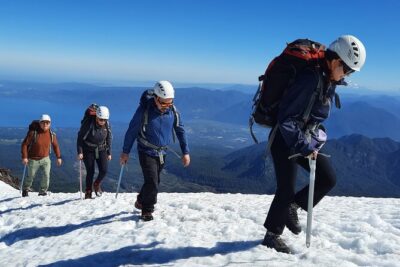
That change is the heart of the experience. You begin with walking sticks on the lower slopes. Higher up, you may use crampons and an ice ax in more exposed areas. Under the direction of the guides, you get a taste of several mountain skills in a single day without signing up for a long expedition.
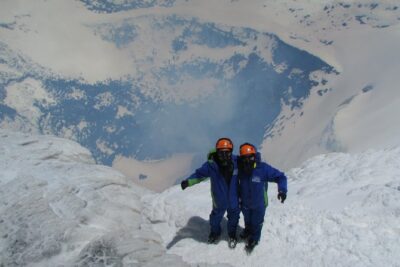
At the top, the reward is the volcanic activity itself. You may see fumaroles, and if conditions allow, incandescent magma inside the crater. That possibility is never a guarantee. Weather, visibility, and current safety restrictions all matter, but even the fumarole activity gives the summit a sense of purpose beyond simply reaching a high point.
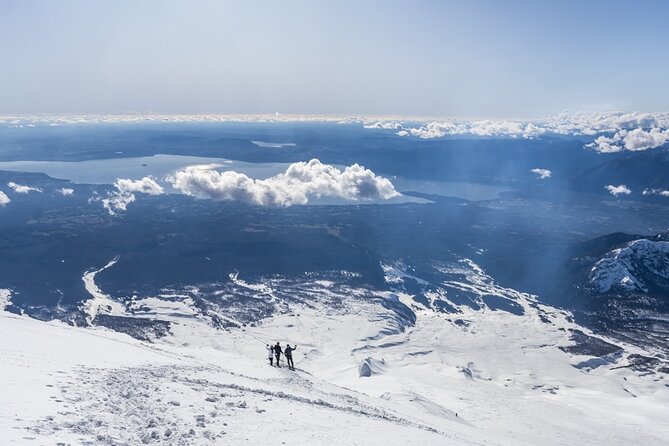
The return offers a different view. From the descent, you can look across the lakes around Pucón and see the shape of the surrounding region. The same route that felt steep and effortful on the way up becomes a broad scenic setting on the way down.
A few more Pucon trips worth comparing side by side
- Villarrica Volcano ascent
★ 5.0 · 430 reviews - Guided Ascent to the Villarrica Volcano from Pucón
★ 5.0 · 220 reviews - Pucón: Villarrica Volcano Climb
★ 4.8 · 191 reviews
A 6:00 am start and a nine-hour mountain day
You meet at Pedro de Valdivia 205 in Pucón at 6:00 am. The early start is not a minor detail. A volcano climb needs time for the ascent, pauses, changing conditions, and the return, so your morning begins before most of Pucón is properly awake.
The full outing lasts about nine hours, but three of those hours are transfer time. That leaves roughly six hours for the mountain portion, though the exact split will depend on the group, weather, pace, and conditions on the route.
The activity ends back at the same meeting point. It is worth keeping the rest of your day light. After a 1,700-meter ascent and a long descent, you may want food, water, and a quiet evening rather than another major excursion.
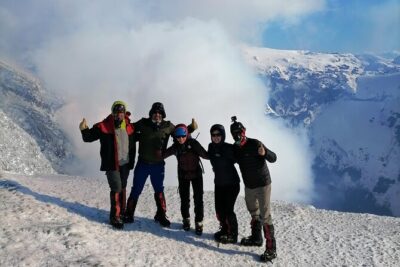
The group limit is 12 people. That is small enough to keep the outing personal, though the number of guides can vary. One outing used four guides for a small group, while another was handled by one guide for three people. This matters because mountain pacing is rarely identical from person to person. Several guides can help keep the group together and give more attention to tired climbers.
The equipment check before the climb
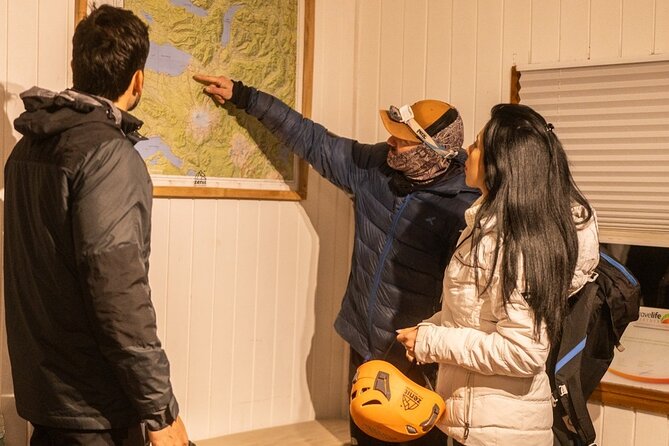
Zenit arranges a meeting at the agency the day before the climb to explain the next day and try on trekking boots. I consider this one of the most useful parts of the arrangement.
Boot fit can make or break a long mountain day. A poor fit can cause rubbing, discomfort, and trouble using crampons. Trying the boots before departure gives you a chance to raise problems before you are high on the volcano.
The equipment supplied for the ascent includes the main technical items described for the route. You will use sticks during the lower walk, then crampons and an ice ax in the more exposed snow and ice sections. The agency also supplies the gear needed for the climb, according to the detailed account of the outing.
You should still treat the fitting seriously. Tell the staff if the boots feel tight, loose, or uncomfortable. This is not the moment to be polite about an issue that could follow you uphill for hours.
The lower route: steady walking toward the snow
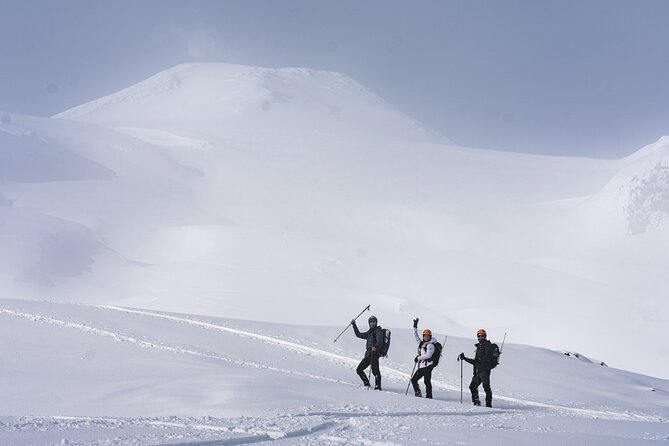
The lower part of the ascent begins more like a demanding hike than a technical climb. You walk with sticks and gain height steadily. The route eventually rises toward the snow line, where the character of the day changes.
There may be a snow lift on the first stretch. The wording makes this a possibility, not a promise, so you should not assume it will remove the hard work. Even with a lift, the total elevation gain remains about 1,700 meters.
This early section is where you find your pace. Moving too quickly at the bottom can leave you short of energy later, when the slope becomes more exposed and the air feels thinner. The guides set the rhythm and use stops to help the group recover.
The human side of the guiding is a major strength here. Luisa and Felipe are praised for being friendly and enjoyable company, while Agustin, Luiza, Leo, Edgar, and Jorge are also named as part of the Zenit team connected with a successful ascent. The strongest praise focuses on patience, attention, encouragement, and help during the hardest sections.
That is exactly what you need on this route. A good guide cannot change the slope, but can help you manage effort, equipment, and nerves.
Still Chile, but an entirely different landscape:
- Villarrica Volcano Ascent
★ 5.0 · 99 reviews - Guided Kayak Trip on Liucura River
★ 5.0 · 87 reviews - Full Day Mountaineering to Villarrica Volcano from Pucón
★ 5.0 · 62 reviews - Horseback Trailride Excursion
★ 5.0 · 48 reviews
Crampons, an ice ax, and the upper mountain
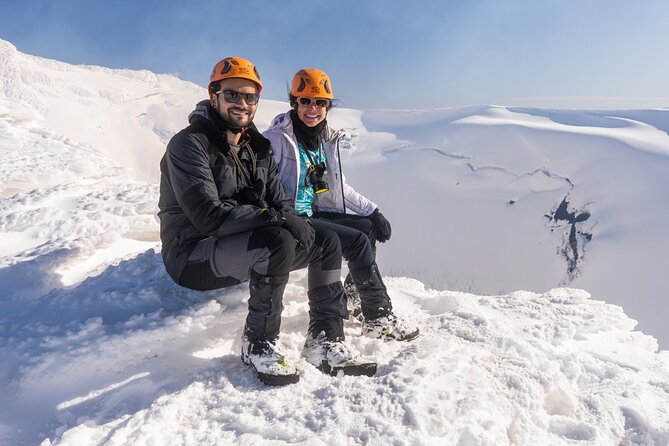
Once you reach the snow and ice sections, the climb becomes more technical. You put on crampons and use an ice ax, with the guides showing you how to move through the more exposed areas.
This is not presented as an advanced mountaineering expedition, but it is far beyond an ordinary day hike. The activity requires a moderate level of physical fitness, and you should be comfortable with a long uphill effort. The supplied information does not give a minimum age, a detailed medical standard, or a precise pace, so you should judge your ability honestly and ask Zenit if you have a medical concern.
The route can be tiring. One successful climber specifically credited the guides with helping the group through the difficult moments when fatigue began to build. Regular pauses and encouragement can make the difference between continuing and turning back.
Do not read the nine-hour duration as nine hours of sightseeing. You are spending much of the day moving uphill, resting, changing equipment, and returning. The fun parts are real, but they are attached to a demanding physical effort.
The summit, fumaroles, and changing crater rules
The summit area is the most unusual part of the climb. Villarrica is sacred to the Mapuche people and remains volcanically active. From the top, you may see fumaroles, and good weather might allow a view of incandescent magma inside the crater.
The phrase if the weather allows deserves attention. Cloud and poor visibility can block views even when the climb itself is possible. One ascent took place in extremely bad conditions, with visibility reduced to about 10 meters. That climber still reached the crater area, but could not see the opposite side and found the descent particularly difficult.
Safety rules can also change access. During one recent outing, reaching the edge of the crater was prohibited because of intense volcanic activity. The group still had a worthwhile climb and enjoyed the descent, but the final experience was different from the full crater visit some people imagine.
You should book this for the mountain experience, not for a guaranteed look at lava. If you get the fumaroles, clear views, and a glimpse of incandescent activity, consider it a bonus from a very changeable volcano.
The descent, lake views, and snow sliding
The downhill route gives you a chance to look outward. Views across the lakes near Pucón and the surrounding geography help explain the setting in a way that a town viewpoint cannot.
The descent is also where the tour gets playful. Some sections can be completed by sliding down snow on a board, a technique described as skibunda or snow tobogganing. After hours of climbing, this can feel like a proper prize.
It is still not effortless. Poor visibility, frost on glasses, cold, and muscle cramps can make the descent difficult. One climber described a severe thigh cramp and trouble seeing because of frost on the lenses. That experience ended safely, but it is a useful warning to keep the descent in perspective.
Take care with your eyewear and clothing, and listen closely to the guides. Snow sliding sounds easy, but control and visibility matter. The guides remain important all the way down, not just during the technical ascent.
Weather is the key factor in your decision
The success of this outing depends heavily on weather. Zenit requires good conditions, and if poor weather forces cancellation, you are offered another date or a full refund.
If your schedule allows, give yourself a buffer of at least four days in Pucón. That advice comes directly from the realities of Villarrica: conditions can change quickly, and you may need to shift the climb to a better day. A tight itinerary with no spare time makes the volcano a gamble.
You can cancel for a full refund up to 24 hours before the 6:00 am start. Changes or cancellations inside that period are not accepted for a refund, except when the operator cancels because of poor weather under the stated policy.
The best strategy is to schedule Villarrica early in your stay, then keep later days flexible. If the first attempt is postponed, you still have a chance to go. If you schedule it on your final morning, your options are much narrower.
Is $195 good value?
At $195 per person, the price is not cheap, but it covers an experience that would be difficult to arrange casually. You are paying for guides, transfers, technical equipment, the agency briefing, and support on a high-altitude volcanic route.
The small group limit also improves the value. You are not being moved through the day in a huge crowd, and the guide-to-climber ratio can be especially helpful when some people slow down or need extra encouragement.
The price is strongest for you if you need equipment and want professional support. Buying or renting crampons, an ice ax, suitable boots, and other mountain gear separately could quickly complicate the day. Zenit’s pre-climb fitting removes much of that work.
The value is weaker if you want a guaranteed crater view. No company can promise clear weather, visible lava, or unrestricted crater access. You are buying a guided attempt on an active volcano, not a fixed sightseeing product.
Who should choose this ascent?
I would choose Zenit if you want a genuine physical challenge and have enough time to wait for good weather. It suits people who are comfortable with a long day, a 1,700-meter climb, changing snow conditions, and the possibility that the summit view may not appear.
It is also a good choice if you are new to this kind of mountaineering but want professional instruction and supplied equipment. The route introduces sticks, crampons, and an ice ax under guide supervision, rather than asking you to arrive with a full personal kit.
I would think twice if you have only one free day in Pucón, dislike early starts, or are looking for a relaxed volcano excursion. The physical demand is real, and the weather may give you effort without the wide views you hoped for.
The guiding team is the clearest strength. The names connected with the strongest accounts include Luisa, Felipe, Agustin, Luiza, Leo, Edgar, and Jorge. The praise centers on friendly communication, patience, safety, and encouragement when the slope gets hard.
Should you book Zenit’s Villarrica climb?
Book it if you want one of Pucón’s biggest outdoor challenges and can keep your schedule flexible. The combination of an active volcano, supplied technical gear, small groups, strong guide support, lake views, fumaroles, and snow sliding gives the day real variety.
Do not book it expecting perfect weather or a guaranteed look into the crater. Allow four or more days if possible, arrive ready for a serious climb, and treat the summit view as weather-dependent. For the right person, $195 buys a memorable mountain day. For someone seeking easy sightseeing, it is the wrong tool for the job.
FAQ
Where does the Villarrica Volcano ascent start?
The activity starts at Pedro de Valdivia 205, 4920552 Pucón, Araucanía, Chile. It begins at 6:00 am and ends back at the same meeting point.
How long does the experience last?
The full experience lasts about nine hours. About three hours of that time is used for transfers to and from the volcano.
How high is Villarrica Volcano?
Villarrica reaches 2,847 meters. The ascent described here gains about 1,700 meters in elevation.
Is technical equipment included?
Yes. The experience includes the equipment needed for the climb. You can also visit the Zenit agency the day before to learn more about the outing and try on trekking boots.
Do I need to be very fit?
You should have a moderate level of physical fitness. The climb is long and tiring, with walking, snow and ice sections, crampons, an ice ax, and a substantial elevation gain.
What happens if the weather is poor?
The experience requires good weather. If Zenit cancels because of poor conditions, you can choose another date or receive a full refund. You can also cancel up to 24 hours before the start time for a full refund.
Just added around Pucon
- Trekking Huerquehue★ 5.0 · 6 reviews
- Half day Canyoning activity in Pucón★ 5.0 · 20 reviews
- Ascent of the Llaima Volcano★ 5.0 · 4 reviews
- Trekking trhough Lagos Andinos Trail★ 5.0 · 15 reviews
- 2-day guided ascent to Lanin volcano, from Pucón★ 4.5 · 12 reviews
- Guided ascent of Llaima volcano from Pucón★ 5.0 · 18 reviews
- 2-day Lanin Volcano ascent★ 5.0 · 11 reviews
- Winter Rafting River Trancura★ 5.0 · 9 reviews
Pucon Tours, compared.
Guided Ascent to the Villarrica Volcano from Pucón
Read our review →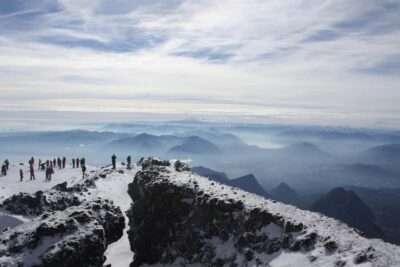
Full Day Mountaineering to Villarrica Volcano from Pucón
Read our review →
Trekking Mirador el volcano + Geometric hot springs
Read our review →Browse the lists this tour appears in